


In early July 2022, at the start of the school holidays, Rob Vinall collapsed outside his house near Zurich and threw up blood. He called an ambulance. It was a hot day, so the paramedic blamed the weather and told him to wait it out. That night he collapsed several more times.
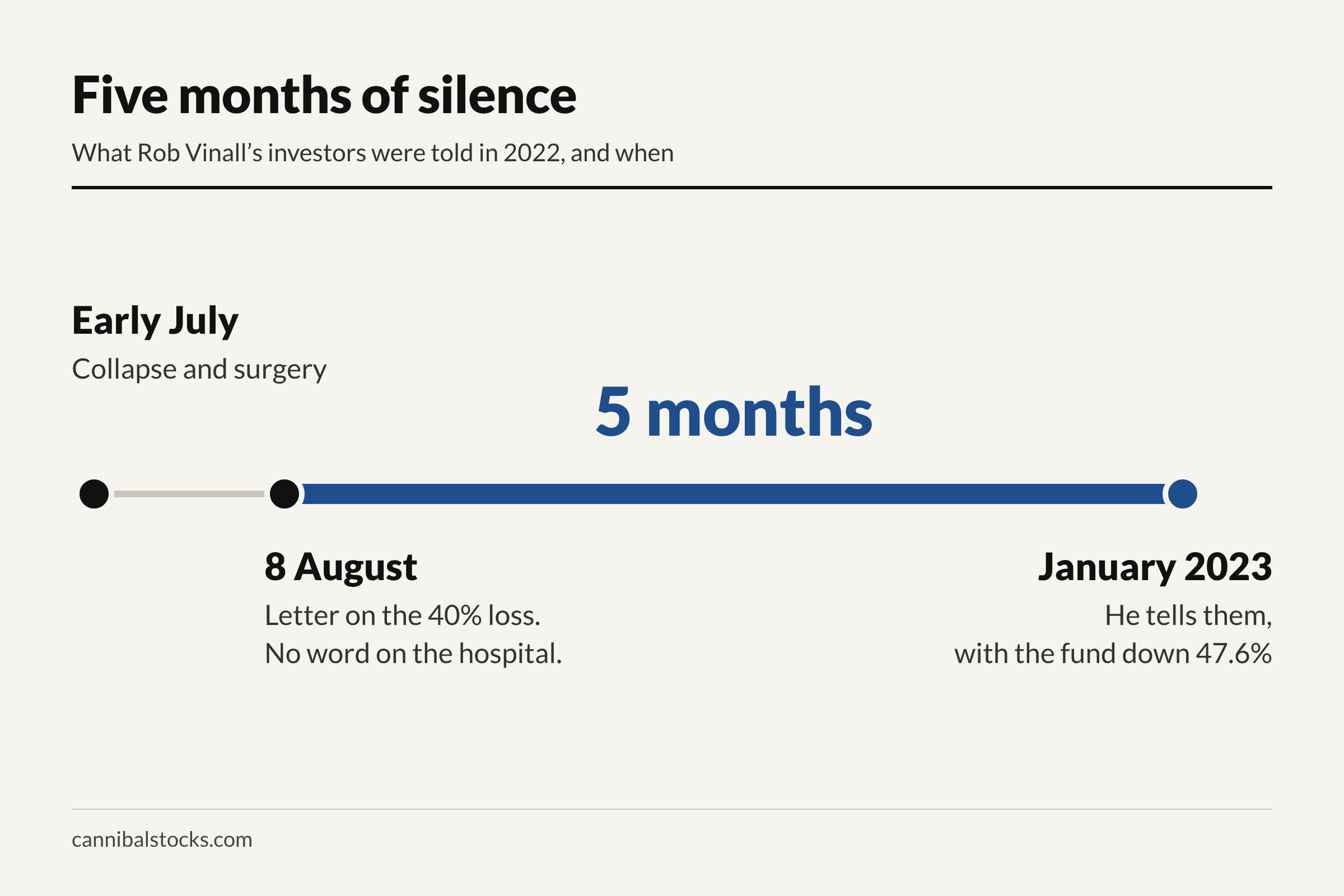
His investors knew nothing about it. What they knew was that the fund had fallen 40% in six months, and that Vinall had just promised them a letter explaining why. He had never announced a letter in advance before. Then the letter did not arrive. Days turned into weeks. Some investors wrote to ask if they had missed it, and others assumed their fund manager had left for the beach.
He was lying in a hospital bed with four tubes coming out of his body. The morning after the collapse a doctor had pushed a camera into his stomach and found a bleeding tumour, 5.5 centimetres across. Stomach cancer is often a death sentence, and the operation was two days away. Of those two days he later wrote
“Frankly, I thought it was game over.”
Until that year he could hardly remember one investment that had lost a meaningful amount. Four years later he has a third of his fund in China, the one market most of his peers refuse to touch. I read every letter he has written since that summer because I wanted to know whether 2022 taught him anything, or whether he is doing it again.
The boy in the yellow stockings
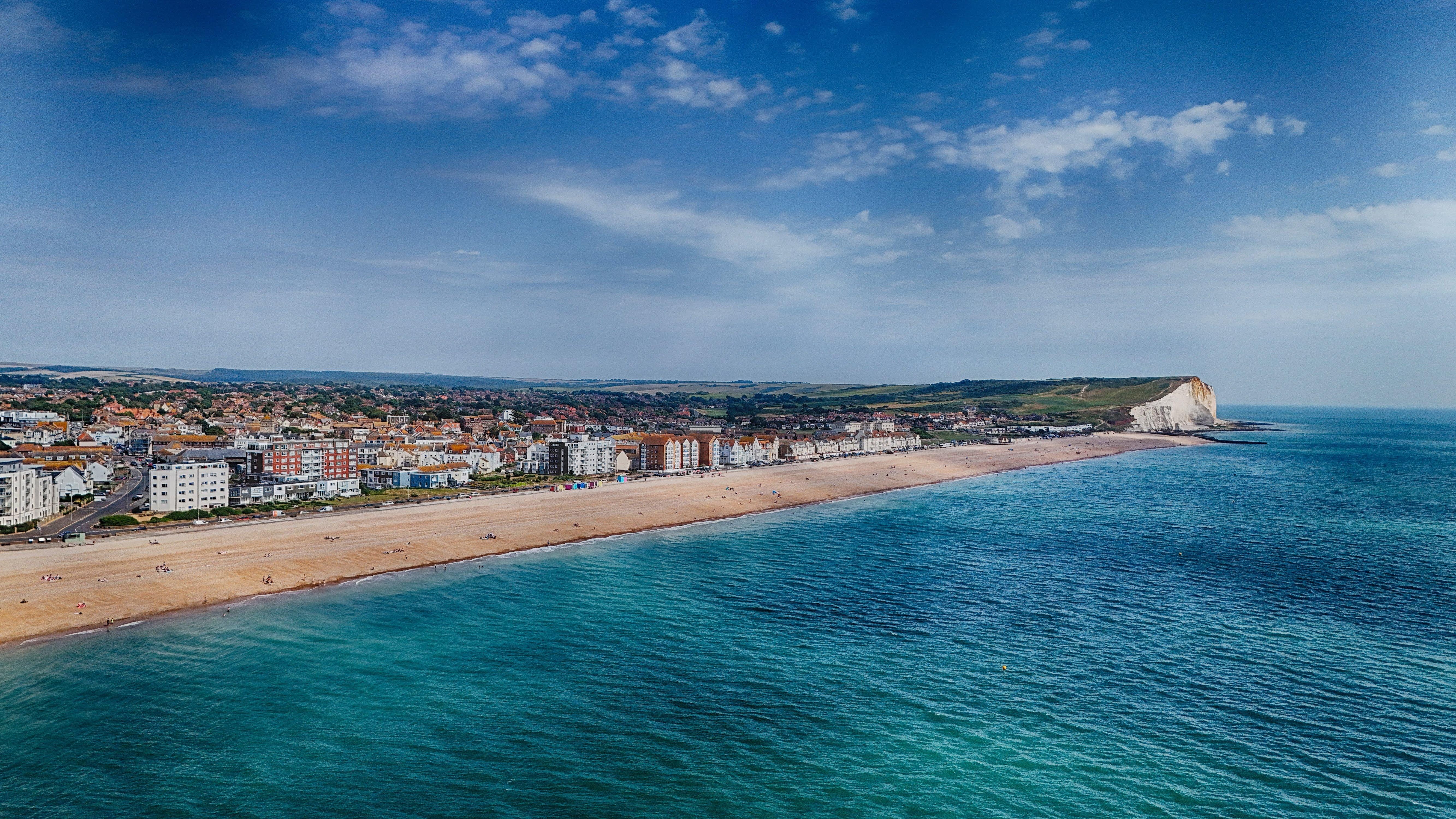
Vinall grew up in Seaford, on the south coast of England, the last stop on the railway line. His father worked at the ferry terminal in the next town, and his mother took evening jobs once his father came home.
When Rob was six, his father was made redundant. The boy did not know the word. He understood it from the disappointment on one face and the worry on the other, and he writes that the feeling is still raw today. His father was given another role soon after, but something had already been decided in that house. The son was going to be financially independent, whatever it took.
A scholarship took him at eleven to Christ’s Hospital, a boarding school for bright children from ordinary families. For seven years he wore its uniform, an ankle length coat, breeches and yellow stockings. Twenty five boys slept in one bare dormitory that froze in winter, and the older ones ate first. He has not set foot in the school since the day he walked out, and he compares it to the way former prisoners feel about their prison.
He studied French and German literature at Cambridge, disliked Goldman Sachs within months, and moved to a mid sized German bank in Frankfurt. Then the dot com bubble burst, and nobody wanted to hear from a telecoms analyst anymore. With nothing to do, he started reading the balance sheets of the fallen stars of Germany’s tech market. Some of them had 100 million euros of cash in the bank and were valued at less than 10 million on the stock exchange. He put every euro he had saved into them, and within a few years he no longer needed a salary.
In 2006 he started his own firm from his home near Lake Zurich. His entire marketing effort, then and since, was one email to his contacts saying he was open for business. The fund opened on 30 September 2008, two weeks after Lehman Brothers went bankrupt, with about seven investors and less than 10 million euros.
Fourteen good years, then 2022
Between 2009 and 2021 the fund had one losing year, and the loss was 1.1%. Vinall kept telling new investors that a crash of 50% was not only possible but certain to come one day. They heard that and concluded he was both talented and modest, which made them want to invest even more.
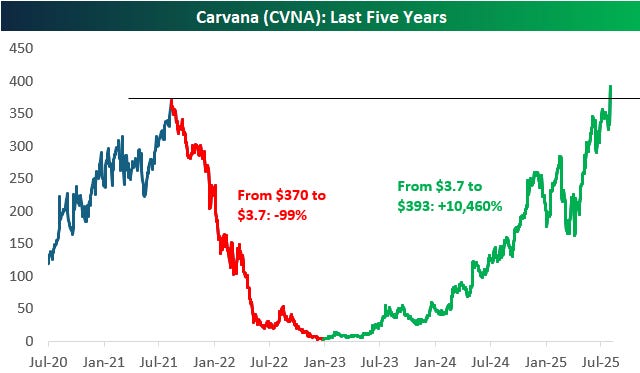
In 2022 his biggest positions fell together. Meta collapsed, his Chinese tech holding collapsed, and Carvana, an online used car dealer loaded with debt, went from 370 dollars a share to 3.55. Vinall says he despises debt and has never borrowed a cent in the fund, yet his first near total loss came from a company that had borrowed too much. The fund ended the year down 47.6%, in a year when the German index lost 12.4%. He was down by half, and he could not blame the weather.
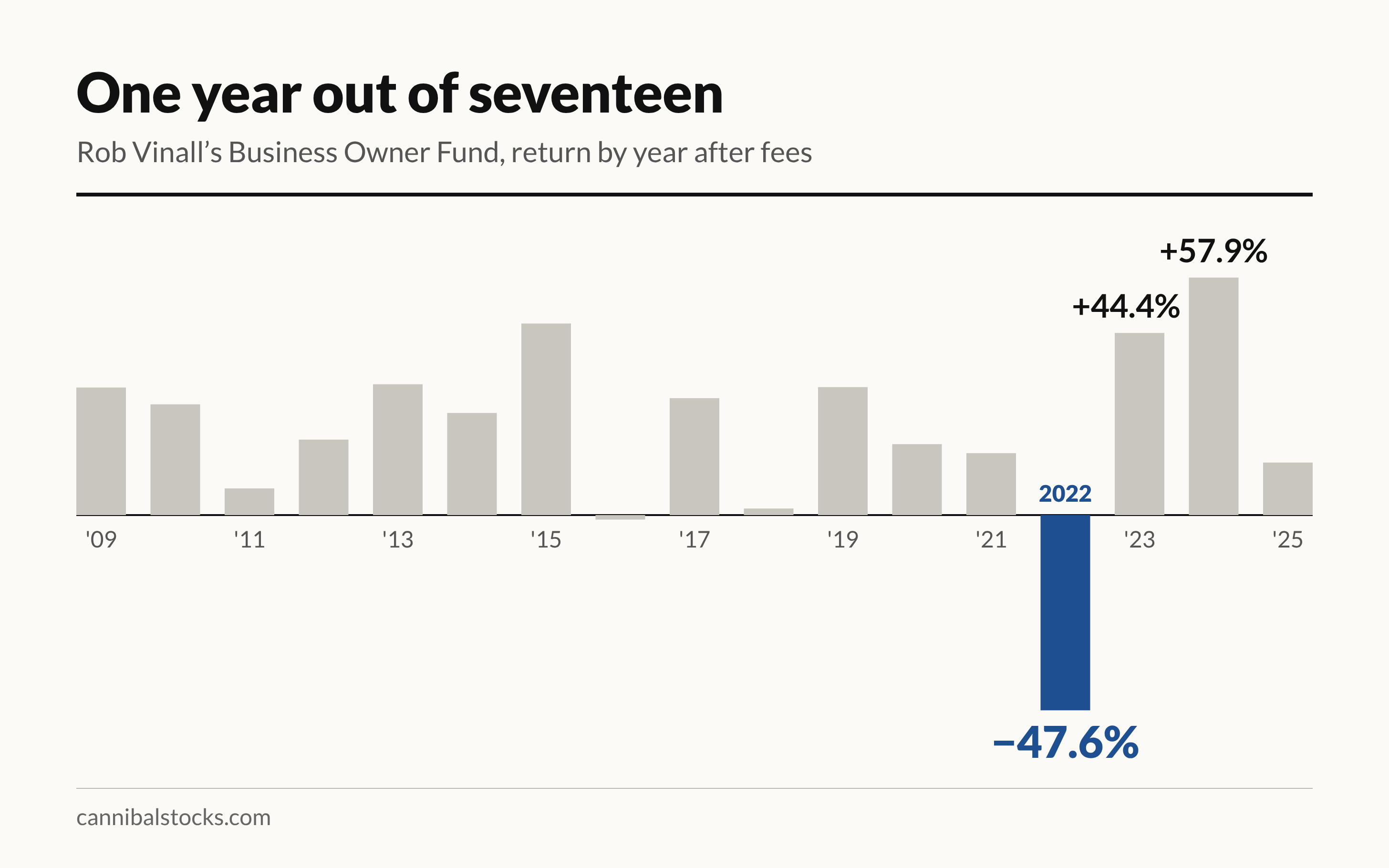
Many managers in that position close the fund and start a new one with a clean record. Vinall stayed, and so did almost all of his investors. He sold the companies he no longer believed in and bought more of the two he thought had been punished unfairly, Meta and Carvana, close to their lows. The fund rose 44.4% in 2023 and 57.9% in 2024, and the Carvana shares he bought at the bottom are up almost twenty times.
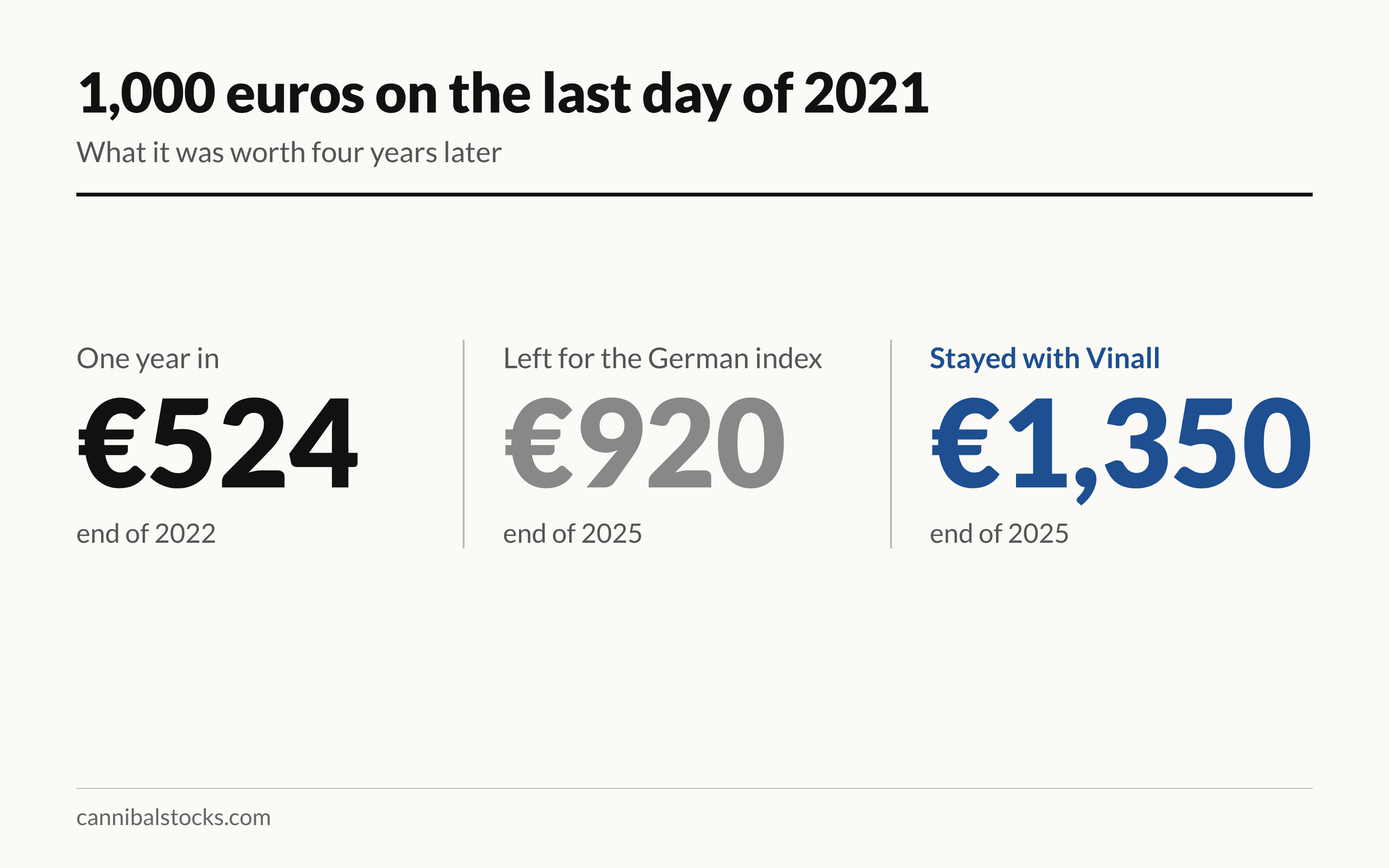
His letters print the return for every year, so I worked out what leaving would have cost. Take somebody who put 1,000 euros into the fund on the last day of 2021, right before the worst year in its history. Twelve months later he had 524 euros. If he gave up there and moved what was left into the German index, he had about 920 euros at the end of 2025. If he stayed, he had about 1,350.
A few people bought. In his letter for 2024 Vinall mentions that 8 million euros came into the fund in 2022, against 14 million that left, and that one of the buyers was a doctor friend who had helped him through the medical emergency. That man had seen the fund manager in a hospital bed and the fund cut in half, and he sent money anyway. Vinall does not say when he bought or at what price. If it was anywhere near the December low of 526 euros a unit, the doctor had more than doubled his money three years later.
By the middle of 2026 the fund had returned 15.5% a year after fees for almost eighteen years, against 7.5% for the German index. Every 1,000 euros from September 2008 had turned into 12,850.
A third of the fund in China
I expected a man who came out of 2022, and out of that hospital, to spread his money wider. He did the opposite.
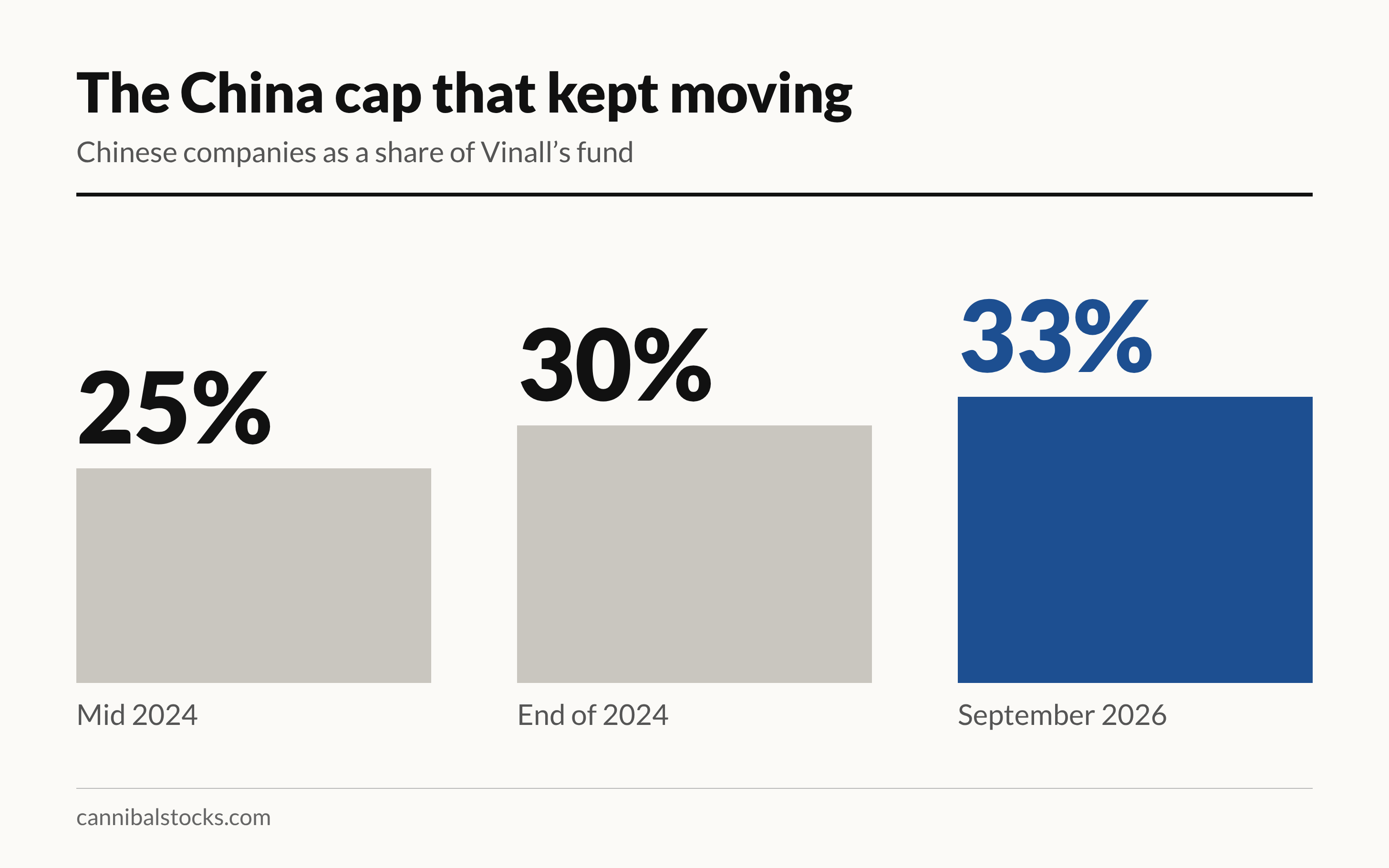
In his letter for the first half of 2024 he counted six Chinese investments, five of them at around 3% of the fund and one at around 10%. That adds up to about a quarter. In the same letter he made his investors a promise, “I will cap the overall China exposure”, and he never said where the cap was. Six months later, when most Western investors called China uninvestable, the share was around 30%. In an interview this September it was a third.
He does not pretend to have an edge there. He describes himself as “a Swiss-based, non-Chinese speaker” and says local investors will always know more than he does. So he looks for founders who still run their companies, low prices, and cash coming back to shareholders, and he spreads the money across several names.
In early November he sent his investors a postcard from Hong Kong and Shenzhen. At an investor conference he sat in meetings with both Western and Chinese fund managers. The Westerners asked what the company does and where it might be in ten years. The locals asked how sales had been the week before, got their answer, and stopped listening. In his view that is why good companies there are cheap. Tencent, his favourite stock, is down about 30% this year and trades at around twelve times earnings.
One name in that postcard caught my eye. He calls Atour his hotel operator and writes that it hands almost a tenth of its market value back to shareholders every year while growing more than 30%, and that the market does not care.
He leaves quickly when something smells wrong. Just before Christmas 2025, Chinese friends sent him a news report that employees of PDD, the company behind Temu, had got into fistfights with regulators who were inspecting its offices. He liked the business and still does. He sold the whole position anyway, and he has since written that he is not sure it was the right call.
Is this Carvana again? I do not think so, and the reason is debt. Carvana almost died because it owed too much. The Chinese companies he describes send cash out to their owners. What he cannot spread is the country. Every one of them answers to the same government, and one bad morning in Beijing would hit them all at once. He knows it, which is why PDD was gone within days of a single news report. The cap has now moved twice, and I would like to hear him name the number.
The letter his investors had been waiting for in the summer of 2022 reached them a few weeks late. It went out on 8 August 2022, about a month after the operation. I went back and read it. It goes through Meta, Carvana and the 40% loss, and it does not mention the hospital. One passage explains what would happen to the fund “should I ever be incapacitated”. Nobody reading it that August knew why it was there. The last line is “happy investing and stay healthy!”
He kept it to himself for five more months. Only the investors who wrote to him directly learned what had happened. The rest read about the tumour in January 2023, in the same letter that told them the fund had lost 47.6%.
The tumour turned out to be treatable and he recovered fully. Of the two days before the operation he writes that he thought about his family and friends, and that nothing else came close. What made him sad was that he would not see how their lives went on. He compares it to being told to leave a very good film halfway through.
On 1 October this year he published a memo to mark twenty years of his firm. He promises the next one in ten years, if his health allows. The last line is for the investors who waited for that letter and did not sell.
“I will not have let them down.”
I have never opened the accounts of a Chinese company. My next post does it with Atour, to find out where that cash comes from and whether it is real.
Cheers, Sandro
Next.
The Atour deep dive is for members. On January 1, 2027 the annual price goes from $169 to $199. Join before that and you keep $169 for as long as you stay.
He survived cancer, Carvana, and a 47.6% drawdown. Naturally, he decided China was next. 🙂
Like & Restack.