


“Everyone is trying to be smart. I’m just trying not to be stupid.” — Charlie Munger
I didn’t plan to write this, but the data forced my hand. This is about a thesis I can no longer defend. The uncomfortable part is how good it looked right up until the moment it stopped making sense.

Confession: I was wrong on Athabasca Oil
Earlier this year I wrote two glowing pieces on Athabasca Oil. I treated it as a classic deep-value setup, with no net debt, huge long-life reserves, a 90-year reserve life, a break-even near $40 WTI and a management team promising to return essentially 100% of free cash flow through buybacks. At a $2.3B market cap against tens of billions in potential lifetime FCF, I called it a company trading at roughly 5% of liquidation value and treated it like a small, NVR-style compounding machine that could quietly melt its share count away.
In hindsight, that was the mistake. The numbers weren’t made up, but the way I connected them was. I treated a highly cyclical heavy-oil producer as if it were a structural compounder and massively underweighted how dependent the whole story is on a very specific macro backdrop.
That’s why I think it matters to walk through the data I’ve dug up now, while the stock is still trading around its all-time high.
Why Long-Term Oil Prices Don’t Excite Me
Athabasca’s outcome ultimately lives or dies with the oil price. The second key lever is the WTI–WCS spread, which decides how much of that headline price actually reaches them. Put together, you get a pure price-taker whose fate is set by two variables it doesn’t control.
In a cyclical commodity, everything starts with supply and demand. Oil demand is huge and will keep growing for a long time. At the same time, the data point to a handful of forces that could keep oil prices relatively low over the long run.
First, there’s a wall of new barrels coming. Every supermajor is now racing into Libya after realizing the breakeven cost is roughly $1–3 per barrel. That is less than what you pay for a coffee. Brazil is ramping pre-salt, Guyana is scaling ultra-cheap offshore production, and Venezuela has a new offshore find in the Orinoco Delta that could add more conventional supply if sanctions keep easing. Add Iraq expanding Basra, U.S. shale still growing (even if slower), and Canadian oil sands doing brownfield expansions now that TMX is finished. On top of that, new offshore frontiers like Namibia and Suriname, the deepwater Gulf of Mexico, and capacity expansions in Saudi Arabia and the UAE add even more potential supply to the system. Put together, the coming wave of new supply could be enormous.
Second, the AI boom is far more bullish for gas than for oil. New data centers in the U.S. are being built next to gas pipelines, gas-fired plants, and dedicated gas turbines because natural gas is the cleanest and cheapest hydrocarbon. If AI really blows out power demand, most of that incremental load lands on gas, not crude. And in basins like the Permian you don’t get to choose — the same well throws off oil, gas, and NGLs together. When gas prices or volumes look attractive, producers drill more “for gas” and flood the market with associated oil as a byproduct. That co-production dynamic means that stronger gas demand automatically brings a big wave of additional oil supply.
Third, technology keeps grinding costs down. Energy companies are deflationary machines, as they drill faster, recover more, and shave dollars off each barrel year after year. Over time they outrun both depletion and inflation, which is why most commodities lose value in real terms over long stretches. They can be fantastic trading vehicles around shocks, but they make poor long-term “buy and hold” assets. In the last energy scare, releasing roughly 1% of global supply from strategic reserves was enough to almost cut the oil price in half. That’s how sensitive the system is to small imbalances and why sustained super-high prices are so hard to maintain.
Finally, politics is now pushing in the same direction as geology and technology. The Trump administration has made cheap energy a core goal, with fewer brakes on drilling, more supply and promises of lower prices to support growth and crush inflation. Cheap fuel is very attractive because it helps GDP, supports households and takes pressure off central banks, so policymakers are constantly tempted to lean against structurally high oil prices whenever they can. Everyone in the system wants cheap oil because low fuel prices keep inflation in check, support growth and make voters feel richer. The current U.S. administration has understood this and built policy around unleashing more supply instead of defending high prices.
I think owning oil producers is a bad long-term bet because technology keeps making energy cheaper, fuel switching and shale co-production keep a lid on oil prices, and these capital-hungry, price-taking companies only look good in short booms that instantly plant the seeds of the next bust.
Why Energy Stocks Still Excite Me
I think the best long-term returns, if you zoom out by industries, will probably come from two places: technology and energy. The problem with technology is that it produces a handful of spectacular winners and a long tail of losers, in a landscape that shifts so fast it’s hard to stay on the right side of change. Energy is much simpler to understand, physics doesn’t get disrupted every cycle, and the basic economics move a lot more slowly.
I don’t think owning oil producers is a great long-term idea, but I do think it’s a very good idea to own companies that help increase oil volumes. For me, that means offshore drillers.
When I look at the big-picture oil data, it’s not crystal clear that we’re heading for a huge supply–demand gap. But when I look at the pipeline of new offshore projects versus the available fleet of modern UDW rigs, the mismatch could be brutal.
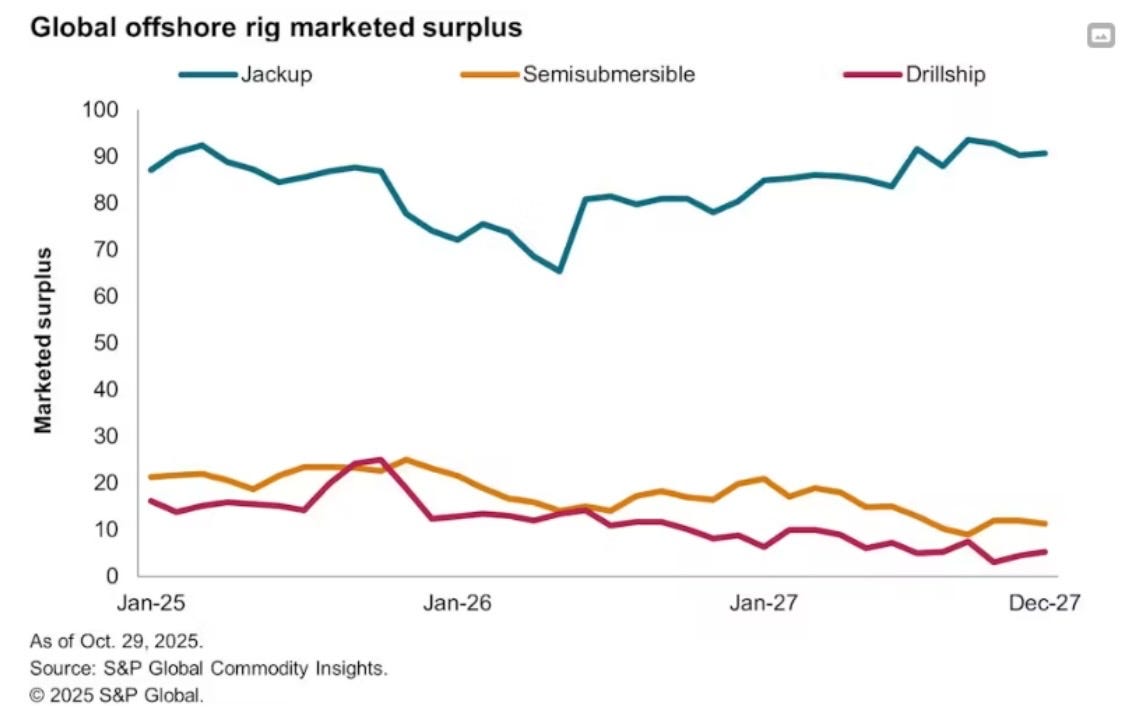
BBG1, the first lease sale in this new Gulf of Mexico cycle, has just finished, and on my numbers it alone is likely to absorb roughly one to three modern ultra-deepwater drillships. But that’s only the first — there are 29 more to come. Add the new project waves in Guyana, Brazil, Suriname, Namibia, Mexico and elsewhere, and it’s hard to avoid the conclusion that we’re heading toward a real mismatch between rig supply and demand. Historically, this is the kind of environment that triggers sharp re-ratings for companies controlling scarce modern UDW rigs. Crucially, drillers don’t need oil at $90+. They just need capital spending to rise, and that’s exactly what’s happening.
And after the recent bankruptcies, I doubt anyone will rush to take a $1 billion bank loan for a new UDW rig, so there is a good chance the existing fleet will only get smaller, not larger.
On the other hand, I do think it still makes sense to own coal producers — not all of them, but the right metallurgical coal names. Met coal is different. It isn’t fungible and it doesn’t really have a substitute. Thermal coal is interchangeable because there are many ways to generate electricity; if you want steel, you need met coal. The data point to a structural supply deficit from around 2028 onward, because high-quality met coal exists in only a few regions, ESG pressure has already shut several mines that are unlikely to reopen, and new greenfield projects are getting harder and harder to permit.
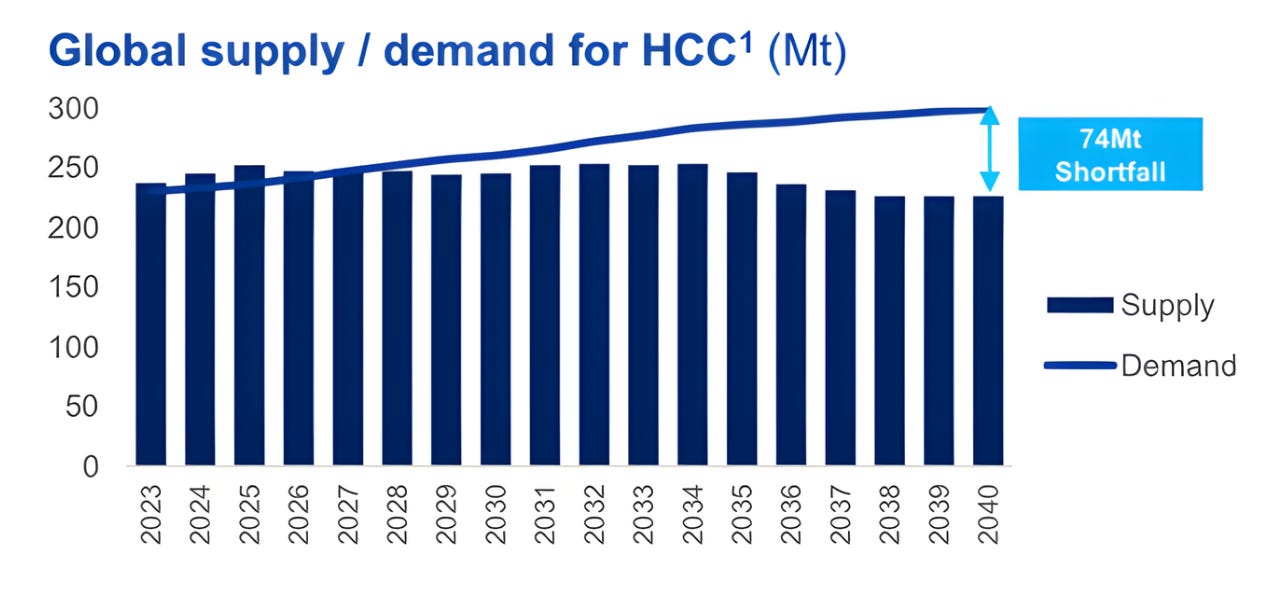
All the major industry forecasts and company commentary I’ve seen from Wood Mackenzie, CRU, Teck Resources, Whitehaven Coal, BHP, Alpha Metallurgical Resources and Warrior Met Coal point to a structural seaborne met coal supply deficit of roughly 40–70+ million tonnes per year over the coming decades, with the IEA as the only major outlier (just to note, they’ve missed global oil demand forecasts 18 years in a row 🙂.)
I would argue that the world will keep using blast furnaces to make steel for many decades, and blast furnaces need met coal. Now that there is a carbon-capture technology that can be added to these furnaces and rolled out quickly and at large scale, this is, for me, the only realistic path forward.
Similar to rigs, the supply of premium seaborne met coal can’t really grow. It exists in only a few regions, once a mine shuts it usually stays shut, banks and insurers are pulling back from “dirty coal”, labour and permits are hard to secure, and even if everything went right it would still take 7–10 years to bring a new mine online. So, I like this bet.
To be clear, I still think owning Athabasca Oil can work out fine. It’s a well-run, debt-free company that’s returning free cash flow to shareholders through buybacks. I also think we will soon see the biggest global oil companies looking for assets in Canada. Athabasca looks like a natural takeover candidate because it is small, debt free and has large long life reserves, and that is where I see most of the upside. For me that makes it a special situation, not a core investment I want to hold for decades. If no deal ever comes, I would still rather keep the bulk of my capital in the coal and offshore names, where the balance between risk and reward looks much better.
“If you don’t learn to constantly revise your earlier conclusions and get better, you’re like a one-legged man in an ass-kicking contest.” - Charlie Munger
Cheers,
Sandro