


On January 30, Alpha released preliminary, unaudited Q4 2025 results.
They did it for three reasons.
First, narrative control. Q4 looks ugly on a GAAP basis with a loss and negative margin. If they waited until late February, the market would fill the gaps on its own. This lets them frame what is one off, what is timing, and why Q4 is not the new normal.
Second, separating price timing from the quarter. They emphasize that most of the met coal price improvement came late in December, so the benefit shifts into Q1 2026. That prevents investors from assuming the business is structurally worse than it is.
Third, setting up Q1 and the earnings call. They provide an early framework, highlight strong liquidity, and show there is no near term financial stress. That way the call can focus on forward positioning instead of defending a messy quarter.
Alpha Q4 2025 preliminary results
Q4 looked weak under GAAP. GAAP is standard accounting, and it often includes one off and non cash items that do not reflect how the business actually performs day to day.
Alpha had a net loss of $17.3 million. That is a loss of $1.34 per share.
But the operating story was not as bad. Alpha reported Adjusted EBITDA of $28.5 million. They use this number to show the business before many accounting items.
A big reason for the gap was a one time problem. The Rolling Thunder mine had flooding in November. Alpha said about $6.1 million of recovery and idle costs were related to that event. They removed that cost from Adjusted EBITDA. Their message is that this was unusual and not a permanent hit.
They also explained the timing of met coal prices. Prices improved in the fourth quarter, but most of the improvement came late in December. That means much of the benefit should show up in Q1 2026, not in Q4.
They said costs were controlled well. Non-GAAP cost of coal sales was $101.43 per ton in Q4, and full year costs ended near the low end of guidance.
Liquidity was strong. Total liquidity was $524.3 million at year end, including $366.0 million of cash and cash equivalents. Long term debt was only $13.4 million.
They also updated buybacks. The program allows up to $1.5 billion. Since the start of the program, Alpha has bought about 6.9 million shares for about $1.1 billion. In Q4 they spent about $20 million and bought about 113,000 shares. That implies an average buyback price of roughly $177 per share. Shares outstanding were 12,805,909 at year end.
How Q1 2026 could look for Alpha
Management is already pointing to better met coal pricing. They said most of the price improvement showed up late in December, so the benefit should land mainly in Q1 2026, not in Q4.
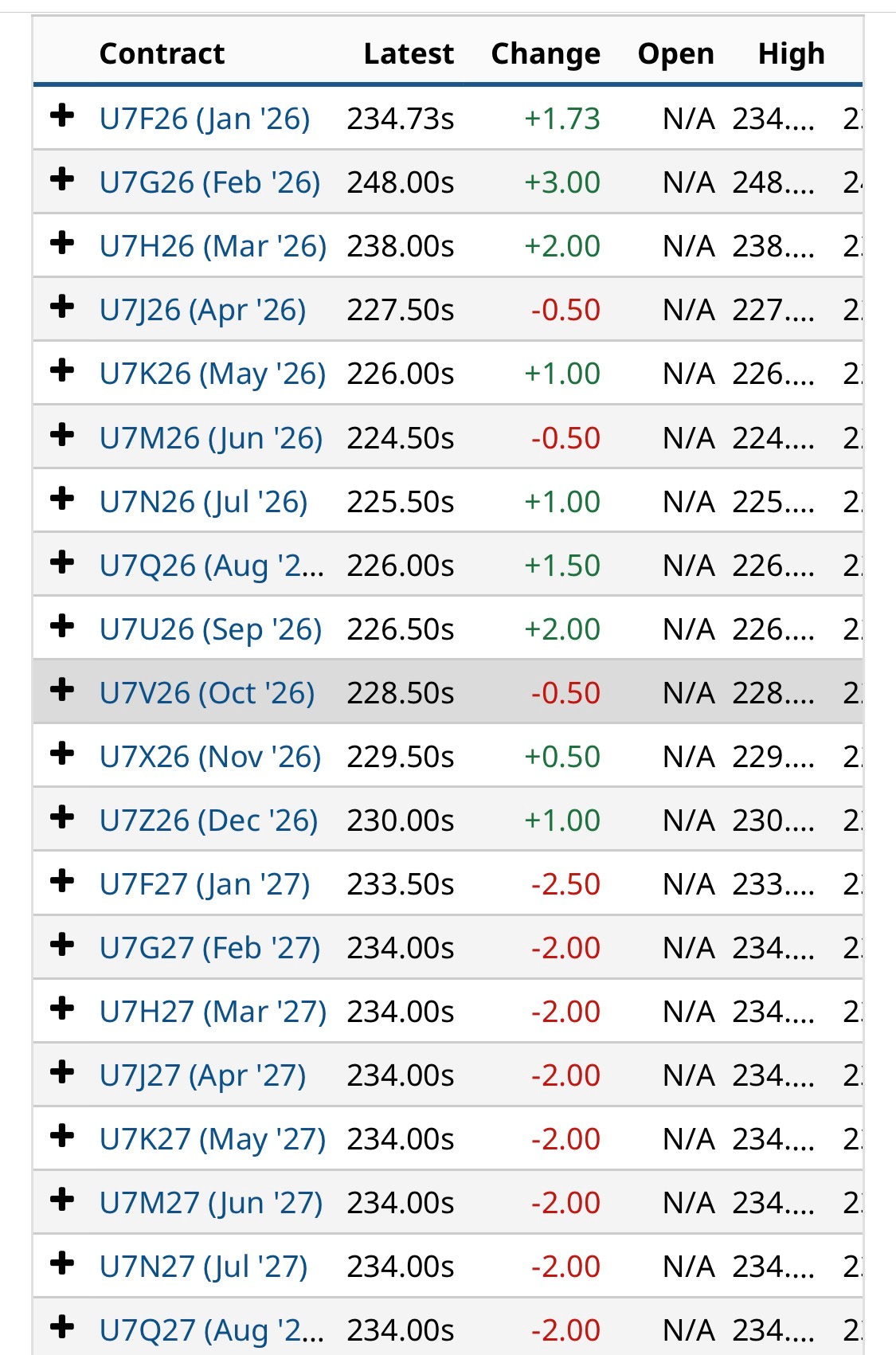
The futures curve sits today roughly in the $235 to $250 per ton range for the seaborne Australian benchmark, with the front quarter around $240 on average. Alpha will not realize that benchmark one for one. Their Q4 realized price was only $115.31 per ton because of mix, contract formulas, domestic exposure, and lag.
For Q1 I assume tons sold stay around 3.8 million and cost stays near $101 per ton.
If realization is $150 per ton, Adjusted EBITDA could be around $160 million. Free cash flow could land around $100 to $130 million.
Every $10 per ton increase in realization on 3.8 million tons adds about $38 million of revenue. A practical rule of thumb is that it can translate into roughly $25 to $35 million more EBITDA and about $15 to $25 million more free cash flow, depending on costs and cash timing.
My base case, with no extra data, is Q1 free cash flow around $120 million, with a wide range from about $60 to $170 million. The main swing factor is how much of the benchmark jump actually flows into Alpha’s realized pricing, and how fast.
Investing is a long term game
I still see Alpha as a great company. It has no debt, and it should return most of its excess free cash flow to shareholders.
Management saw weakness in met coal prices and responded the right way. Keep costs tight, keep liquidity high, keep buying back stock.
In weak years, I think Alpha could lose a little money because its production costs are not the lowest. In strong years, it can generate up to $1 to 2 billion of free cash flow.
If Alpha can retire 80% of the shares over the next decade and still produce $1 billion of free cash flow in a year, at what price would the remaining shares likely change hands?
In that case, my base scenario suggests the shares could change hands at roughly 25 times today’s price.
For me, Alpha is a set it and forget it option.
We are also approaching the Chinese Lunar New Year, a period when demand from China traditionally slows, which often puts short term pressure on prices.
Cheers, Sandro