


Over the past few days, several subscribers have pointed me to a new write-up on Athabasca Oil by a well-known oil and gas analyst. It’s a paid piece, so I won’t name the author or quote it directly, but it has sparked quite a bit of discussion. Different perspectives deserve attention, so let’s take a closer look.
The author’s main thesis is straightforward: we’re at the top of the cycle, and Athabasca’s profitability is peaking as heavy oil discounts are set to widen again.
In this post, I’ll go through each of his main points — not to defend or attack, but to test them against actual data and see what holds up. My goal is to stay fully objective and focus on facts, not opinions.
Here are the key claims from that analysis, which I’ll examine one by one:
The WCS discount has narrowed due to TMX pipeline exports.
High profitability will trigger overproduction.
Overproduction will widen the discount and crush margins.
Athabasca carries significant debt and follows a risky cash strategy.
The industry is at a cyclical peak — time to sell.
After that, I’ll step back to review the macro backdrop before zooming in on Athabasca’s fundamentals, to see what the numbers actually tell us about where the company might be heading next.
Time to separate data from narrative.

The WCS discount has narrowed due to TMX pipeline exports
— True
Before diving into the analyst’s points, I’d like to briefly explain how Athabasca actually makes money.
Athabasca doesn’t sell the same kind of oil as most U.S. producers. Athabasca’s heavy oil is used in U.S. refineries because it produces the diesel that America’s light crude cannot supply in sufficient quantities. While the U.S. market trades the light, sweet crude known as WTI, Athabasca produces a heavier, thicker blend called WCS. Because WCS is lower quality and more expensive to transport to refineries, it always trades at a discount to WTI.
That difference — the WCS discount — is the heartbeat of Athabasca’s business model. It determines how much money the company actually makes. If WTI trades at $80 per barrel and the discount is $15, Athabasca effectively receives $65. If the discount widens to $20, it earns just $60. Production costs remain roughly $40 per barrel, so every extra dollar of discount directly eats into profit. The lower the WCS discount to WTI, the better for Athabasca Oil. That’s why anyone analyzing Athabasca needs to focus not just on oil prices but on the spread between WTI and WCS.
And the sensitivity is huge. According to the company’s latest data, every $1 change in WTI moves annual cash flow by about C$10 million, while every $1 change in the WCS differential moves it by roughly C$17 million. So if the discount widened from $15 to $20, Athabasca would lose around C$85 million in yearly free cash flow.
The reason for the discount is simple: WCS is heavier, harder to refine, and must travel farther to reach refineries. When pipelines are full, the discount grows and when new ones like TMX open, it shrinks and Athabasca earns more per barrel.
The TMX pipeline (Trans Mountain Expansion), which began operating in May 2024, increased Canada’s export capacity by around 590,000 barrels per day, giving producers new access to Pacific and Asian markets. While Athabasca itself still primarily sells into the U.S., TMX relieves system-wide constraints that indirectly benefit all producers.
And the author is partly right. TMX did narrow the WCS–WTI spread in 2024, but the change was moderate and structural, not cyclical. After TMX began operating, the discount moved to around US$11–12 per barrel, compared to US$18–20 the year before. As production increased and global demand for heavy oil softened, the spread stabilized in the US$12–15 range, still much better than in the past.
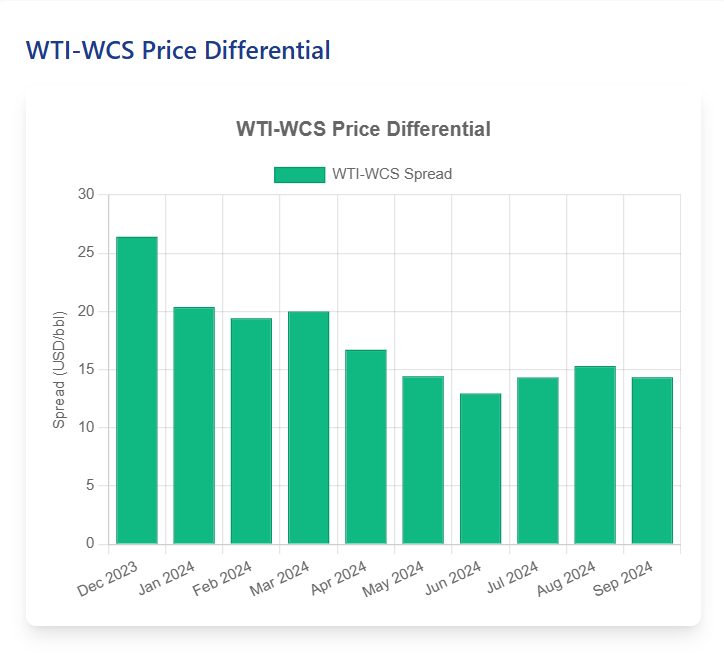
TMX has reduced extreme price swings and removed export bottlenecks that once caused big discounts, like the 2018 –$40/bbl spread. Even with rising production, there is no sign of a structural problem. In short, TMX didn’t cause a short-term squeeze but stabilized the market. The WCS–WTI spread is not collapsing; it’s normalizing around $12–14, a healthy and sustainable range driven by better infrastructure, not overheated demand.
I’m agreeing with the author a lot here — mostly because I’m afraid he might start analyzing my posts next. 😂