


Written on the night of October 14, 2026, a few hours after the filings hit EDGAR.
It is done.
Last night the last signature landed. Brazil’s competition authority approved the Transocean and Valaris combination with no conditions, and with that the list is complete. The Department of Justice signed on September 30, six other jurisdictions before that. Nobody with a government stamp can touch this deal.
What is left is paperwork. The Brazilian approval becomes final after a 15-day waiting period following publication. Both companies vote on November 24. Fredriksen’s Famatown and Oak Hill, 18% of Valaris, promised their votes in February. Perestroika, 9% of Transocean, promised too. Sometime in the first half of December Valaris stops existing.
On that day Transocean owns 68 rigs. Thirty three drillships, seven semisubmersibles, twenty eight jackups. The largest offshore driller in the world. Four of every ten drillships on the planet under one roof, with neither company ordering a new drillship.
It will also have 2.2 billion shares instead of 1.1 billion.
Buffett said investing needs only two courses.
“And I’d tell them I’d only have two courses. One would be how to value a business, and the second would be how to think about markets.”
Today we take both. The market course tells you to be afraid of December. The business course tells you something that should keep every oil major awake.
Course one. What the market does to a buyer who pays with paper
The market has one word for 15.235 Transocean shares per Valaris share.
Dilution.
A billion new shares. If you own Transocean tonight you own all of Transocean. In December you own 53% of something twice the size. The market does not wait to find out what the other 47% earns. Here’s how share prices have historically reacted to major mergers.
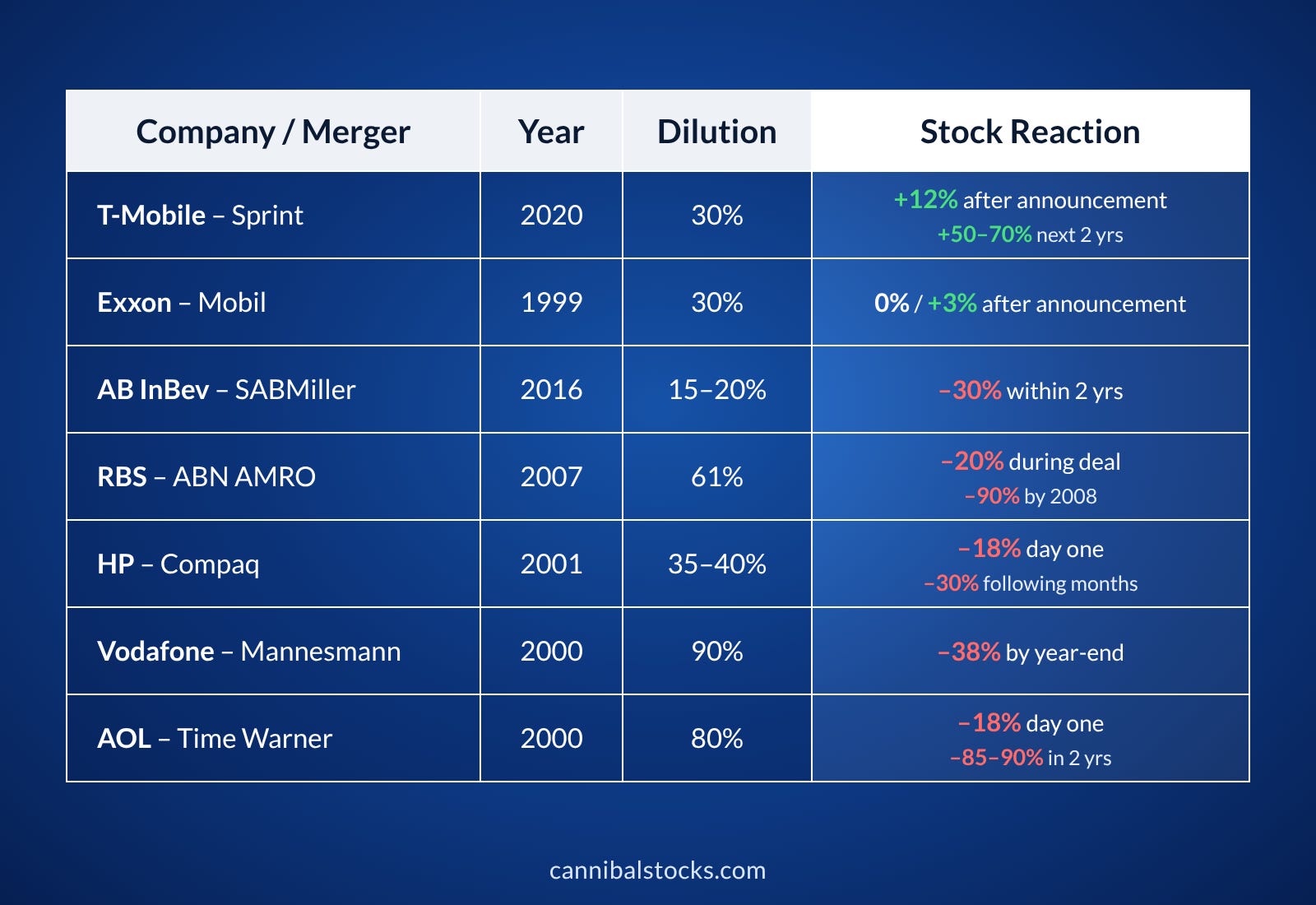
Seven famous stock deals. Five of them cost the buyer’s shareholders money and two of them cost nearly everything. T-Mobile and Exxon survived, and for one reason only. The thing they bought earned more than the paper they printed to buy it.
Offshore has its own rows, and I know them by heart.
September 2018. Transocean buys Ocean Rig for $2.7 billion in cash and shares. The stock falls 6.5% that morning. Two years later it trades below one dollar.
October 2018. Ensco buys Rowan, all stock. Rowan jumps above $20 on the news and sits at $8 three months later. The new company calls itself Valaris. In August 2020 Valaris files for bankruptcy under $7 billion of debt and the old shareholders walk away with some warrants and a story for dinner parties.
The same Valaris. Born from a stock merger that went to zero. Tonight it dies into another one.
And this time? On February 9 Transocean rose 6% on the announcement. Then it ran to $7.66 in May, fell under five dollars in July, and closed tonight at $5.58, a few cents from where it stood before the deal. Mr. Market cheered, then panicked, then shrugged.
In December a billion new shares land in accounts that bought Valaris, not Transocean. Some of those people will sell. The stock can drop on closing day and keep dropping for a week. Let it. The market prices the paper. It has never priced the farm.
“We do not measure the progress of our investments by what their market prices do during any given year. Instead, we evaluate their performance by two measures - whether their earnings have improved and whether their economic moats have widened.”
— Warren Buffett, Berkshire Hathaway, 2007 Shareholder Letter
The stock will do what stocks do. I don’t care much about that. What I do care about is this.
Is the moat bigger now, and will profits be higher?
And one more thing. They told us the offshore supercycle would arrive in late 2026 or 2027. Did they lie to us again?
