


First, an apology.
In my last post I told you we probably would not see Conifer buy again until November.
A new Form 4 landed on Monday. Another 126,000 shares on September 24 and 25, about $32 million at an average of $250 a share. That took the position to around 1.6 million shares, up about 8% in two days. An October 1 filing then showed another roughly 273,000 shares bought, bringing the holding to about 1.9 million shares.
I read the trading restriction as starting when the agreement was signed. It does not. It applies “for so long as the New Director serves as a director on the Board.” Hart joins on November 1. Until then Conifer was free. So it bought.
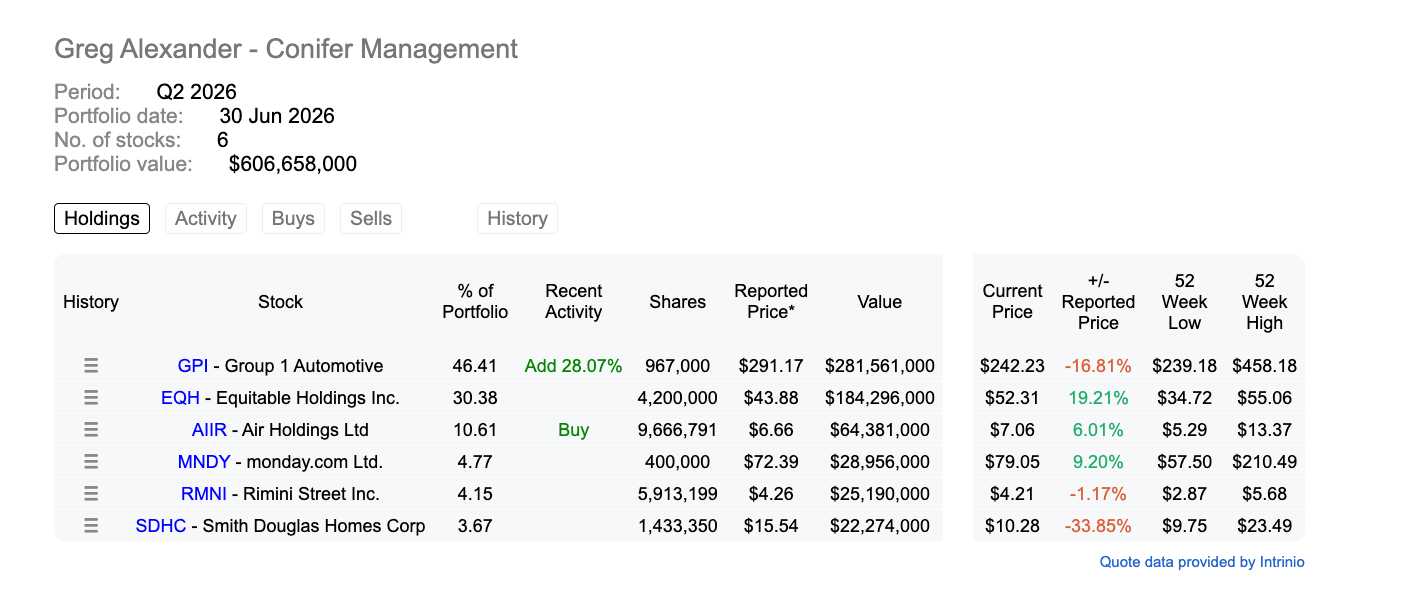
On June 30, Group 1 was 46 cents of every dollar in Conifer’s fund. At today’s price it is more than half. A man Buffett would trust with his money has half his fund in one car dealer.
This setup is getting crazier. 😅
Now the post.
Data and GPI price of $240 as of September 29, 2026. Conifer ownership updated for the October 1 filing.
Last week I left you with a sentence from a CEO.
“Their deep understanding of our industry and Group 1’s competitive advantages and opportunities.”
Competitive advantages. At a car dealer. I have read a lot of press releases and that phrase is usually where the meaning ends. But Daryl Kenningham was not talking to analysts. He was welcoming a new director, and the director works for Greg Alexander.

If you read my July post you know the name. If not, here is all you need. In 2010 Bruce Greenwald told his Columbia class that Buffett had named three people he would trust with his money when he is gone. Klarman. Li Lu. And Greg Alexander, whom nobody in the room could place. Buffett’s biographer Roger Lowenstein was asked about it a year later and answered in seven words.
“I know Greg. I think Warren is right.”
Alexander has run money at Ruane Cunniff, the firm Buffett sent his own partners to in 1969, for forty years. No interview. No letter. Nothing.
This year he sold every share of Lithia, a car dealer he had held for years, and put the money into Group 1. He kept buying as the stock fell, $300 in June, $250 in September. Then he asked for a seat on the board. In every Conifer filing I could find, on any company, he had never done that before. To get it he gave up the right to trade the stock when he wants. You do not sign that if you plan to leave.
My last post opened with Buffett’s coach who stops when he sees a seven-footer. This is the man who sat down on the bench. So I went looking for what he saw.
I expected a moat. I found a cage.
The moat everybody has
Every franchised dealer in America sits behind the same wall. State law says a carmaker cannot sell you a car directly, cannot cancel a dealer without cause, and cannot plant a new store next to yours without a fight. Tesla needed a decade of lawsuits to get around it. Rivian sued Ohio. Scout, Volkswagen’s new brand, got stuck in the South Carolina legislature.
And every dealer has a garage. Cars come back for twelve years after they leave the lot, at margins the showroom never sees.
But on the garage, Group 1 is not even the best. AutoNation gets 48% of its gross profit from parts and service. Group 1 got 44% in 2025.
So if the moat belongs to everyone, and the best garage belongs to AutoNation, the CEO’s sentence needs something only Group 1 has. I will get there. But first a number, because it changes how you read everything Conifer signed.
The number 19
The agreement Conifer signed caps its ownership at 19%.
Group 1’s annual report says its agreements with carmakers contain “change of control provisions related to the ownership of our common stock.” That is all it says now. Six years ago it said more. Carmakers can block any shareholder from going above a set percentage, “ranging from 20% to 50% depending on the particular manufacturer’s restrictions.”
So I went back to 1997, the year Group 1 went public, and pulled the original contracts out of the filing.
Toyota. The right to approve “any ownership or voting rights of Group 1 of twenty percent (20%) or greater by any individual or entity.” If Toyota objects, Group 1 has ninety days to sell its Toyota and Lexus stores.
Nissan. Same words.
GM. If anyone shows more than 20% on a 13D, GM can force a sale of the dealerships to GM “at fair market value.”
Nineteen is one step below Toyota’s line.
The law that keeps Tesla out of the showroom is the same law that decides who is allowed to own Group 1. Toyota does not just protect the franchise. Toyota approves the shareholder list.
Every dealer lives under the same rule. It is a cage, and Alexander walked into it with half his fund. Which raises the only question that matters. Why?
The answer is one paragraph inside the contract. It anticipates what happens if buybacks push Conifer’s stake above the cap before 2030. The October 1 filing brings that possibility closer. Below the line, that paragraph, the three reasons I’d pick Group 1 over Lithia, AutoNation, and Asbury all day long, and the five dollars a share nobody on Wall Street is counting.
