



A ten year old boy wakes up because the ground is moving. He thinks it is an atomic bomb. It is an earthquake. It kills more than 240,000 people in a few minutes.
The boy survives. The family he lives with does not.
It is not his real family. Mao sent his parents to labor camps a month after he was born, so they paid strangers to raise him. Foster homes. Orphanages. Street fights. Then a grandmother who made him read.
Thirteen years later he is a student leader on Tiananmen Square. Then a fugitive. Then a broke refugee in New York with a pile of debt.
In 1993 a friend drags him to a lecture at Columbia. The speaker has a funny name. He thinks it is a lunch. A buffet.
It is Warren Buffett.
His name is Li Lu. Charlie Munger later handed him 88 million dollars of family money and called him the only outside manager he ever trusted. It became 400 million. Li Lu is the man who brought BYD to Munger in 2002, when it was a battery maker nobody had heard of.
This post is not about BYD. It is about yellow boots.
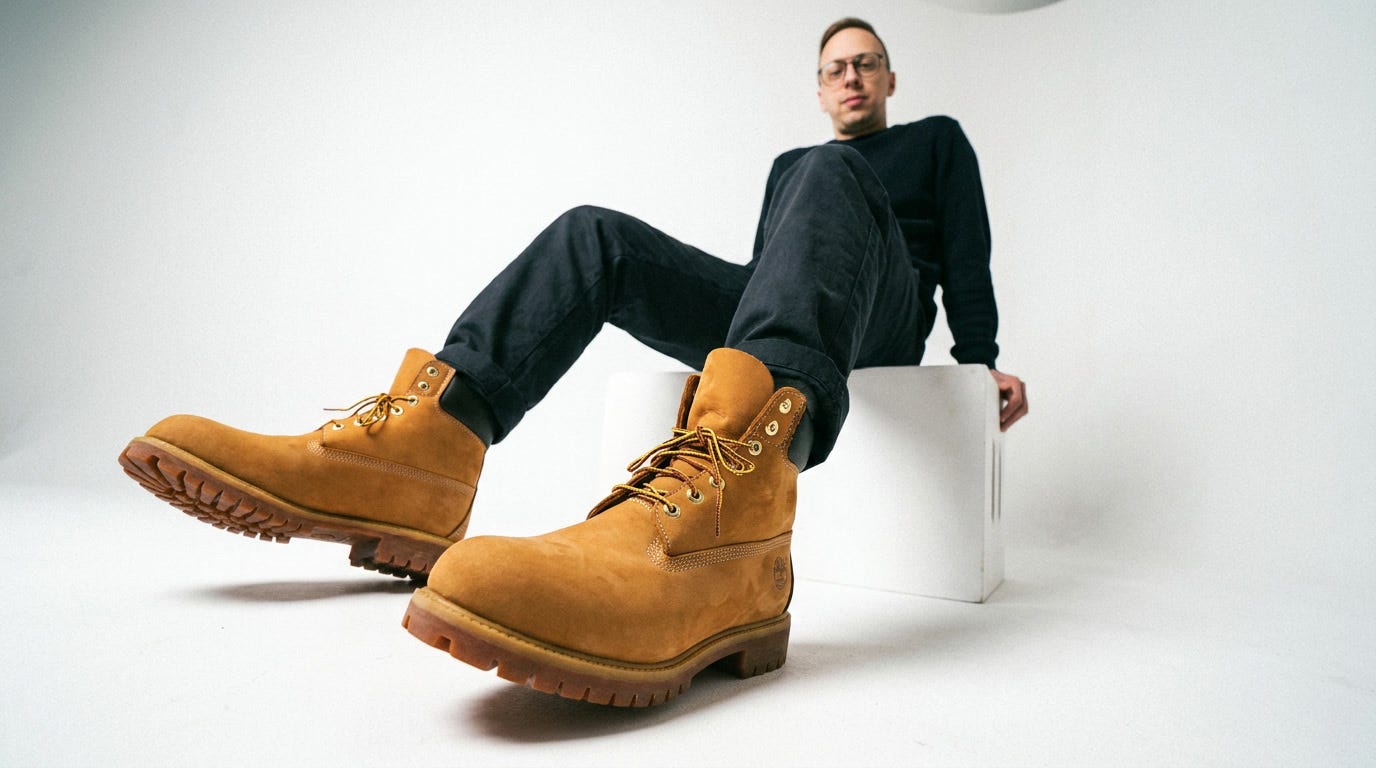
The page
Fall 1998. Li Lu reads Value Line cover to cover, every issue. The first page he turns to is the list of new lows.
Timberland is on it.
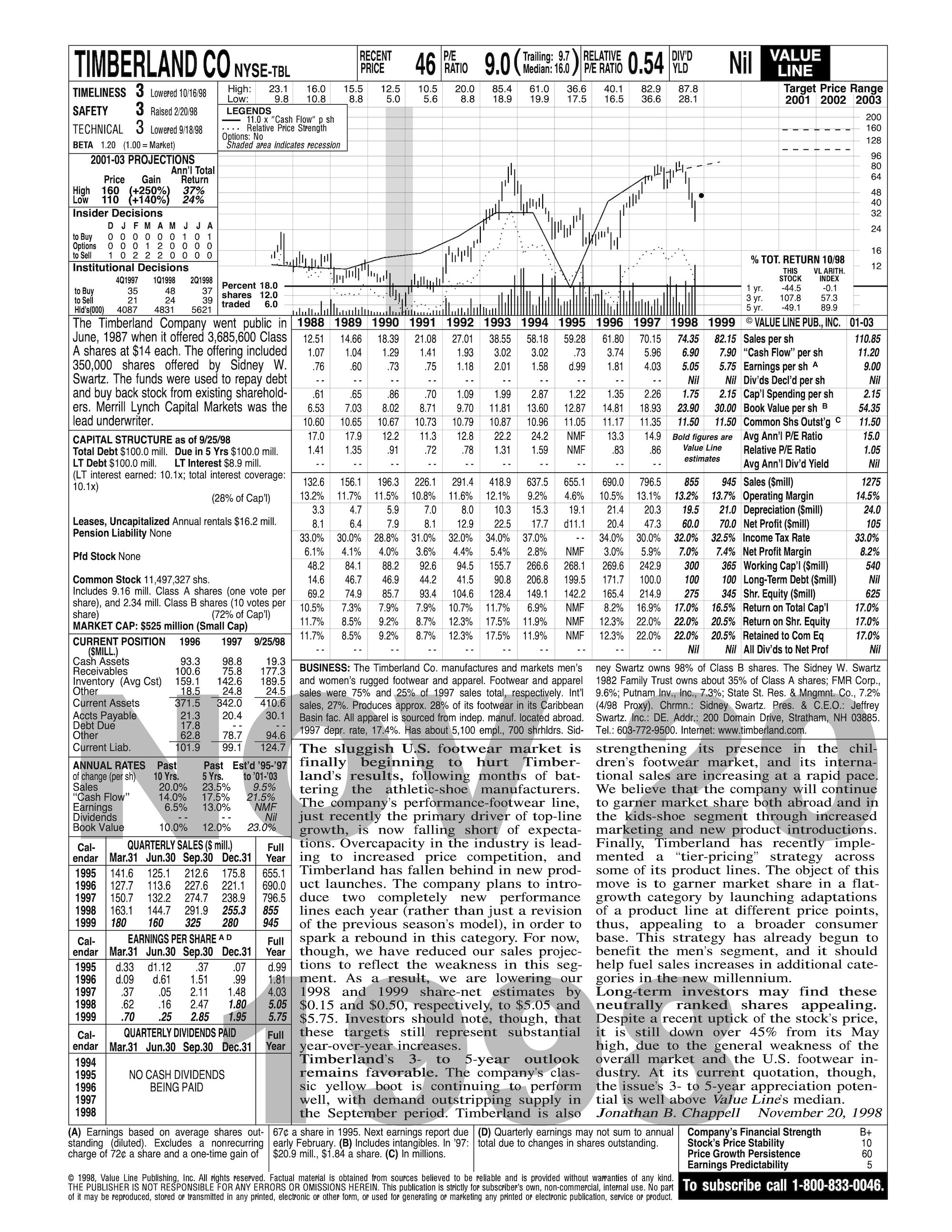
The stock had fallen 55 percent in three months. It was trading around 28 dollars. He does not care where it traded before. He cares whether it is cheap. Eleven and a half million shares at 28. Call it 320 million of market cap.
Book value 275 million. Almost all of it working capital. At the end of September 1998 the company held 177 million in receivables and 189 million in inventory, and retailers turn inventory into cash in Q4. Call it 200 million of liquid assets plus 100 million of buildings and land.
You pay 320 million. You get 300 million of clean, tangible assets. That is the downside.
Revenue 862 million. Net income 59 million. About five dollars a share. Twenty eight divided by five. Five and a half times earnings. Roughly 200 million of capital doing the work. Roughly 100 million of pre tax profit coming out of it. Fifty percent.
A very good business priced like a dying one.
If that took you more than five minutes, Li Lu says you are not a good analyst. 🙂
Why everyone walked past
Li Lu thinks value investors are five percent of all money. The market is built for the other 95. That is where the opportunity is.
What he saw in October 1998 was this. The Asian crisis at its peak. Nike and Reebok watching Asian sales collapse. No analyst covering a company with almost a billion in sales. A family owning 40 percent of the shares and 98 percent of the votes.
And a pile of shareholder lawsuits. Illiquid. Family controlled. Nobody covers it. Lawsuits. Management is probably milking it. Pass.
The journalist
He downloaded every court filing and read every page.
The pile of lawsuits was one complaint filed several times. In the summer of 1994 management told analysts orders were running ahead of plan. Montgomery Securities pencilled in earnings growth of 57 and 71 percent for the next two quarters. Timberland missed. Investors sued.
Sidney Swartz, the CEO, stopped giving guidance. Then he stopped talking to Wall Street at all. His position was that the business is wonderful, I do not need a dime from any of you.
Not crooked. Stubborn.
But were they good? There was no Google. So Li Lu went to their town. Talked to neighbors. Went to their synagogue. Found that the son, Jeffrey, about to become CEO, sat on the board of a company run by a friend of his. So he invited himself onto that board and became the son’s friend.
His verdict. One of the most admirable families he ever met, who also happened to be brilliant business people.
A few weeks. Day and night. His wife was in the audience when he said that, so we know it is true. 🙂
The stores
Margins had been rising for years. Li Lu wanted to know why. So he went to the stores.
Every manager said the same thing. Kids in the inner cities wanted Timberland boots and nobody could keep them in stock.

Now the irony. In 1993 the New York Times had written about Timberland’s appeal to young Black and Hispanic customers. Jeffrey Swartz told the paper that market was not sustainable. Artists dropped the brand. Swartz had to publish a denial of racism and sit down with community leaders.
The customers the company had tried to talk itself out of were the customers carrying its margins. Management underestimated its own brand. Wall Street did not look. The kids knew.
Then he sized the fear. Asia was less than ten percent of a segment that was itself under ten percent of revenue. Wipe it out and earnings fall less than five percent.
At five times earnings.
So he put, and I quote, a shitload into it.
What he did not say
One thing is missing from that lecture.
On October 15, 1998, the month he was buying, Timberland reported record earnings and announced a share repurchase program. The family that would not talk to Wall Street was using the silence to buy its own stock.
In the first quarter of 1999 the diluted share count was 22.2 million. A year later, 20.4 million. Eight percent of the company gone in twelve months. In May 2000 the board raised the authorization to four million shares.
Earnings went 59 million. Then 75. Then 122 in 2000.
More earnings. Fewer shares. A brand people loved. Five times.
You know what I call that.
The sale
Jeffrey Swartz liked to talk. He started holding analyst meetings. At the first one three people showed up. Swartz, Li Lu, one analyst. At the last one he attended, end of 2000, the room held sixty. Wall Street was initiating coverage.
He sold everything.
The stock split twice on the way. In 2000 alone it rose 168 percent while the market fell. Bought at 28, it was worth over 200 on his cost. He calls it seven times in two years.
And it never traded above fifteen times earnings. Five to fifteen, while earnings grew 30 percent a year and shares disappeared.
In 2011 the grandson sold the company to VF Corp for 2.3 billion in cash.
Twenty seven years later
Now I am going to tell you something.
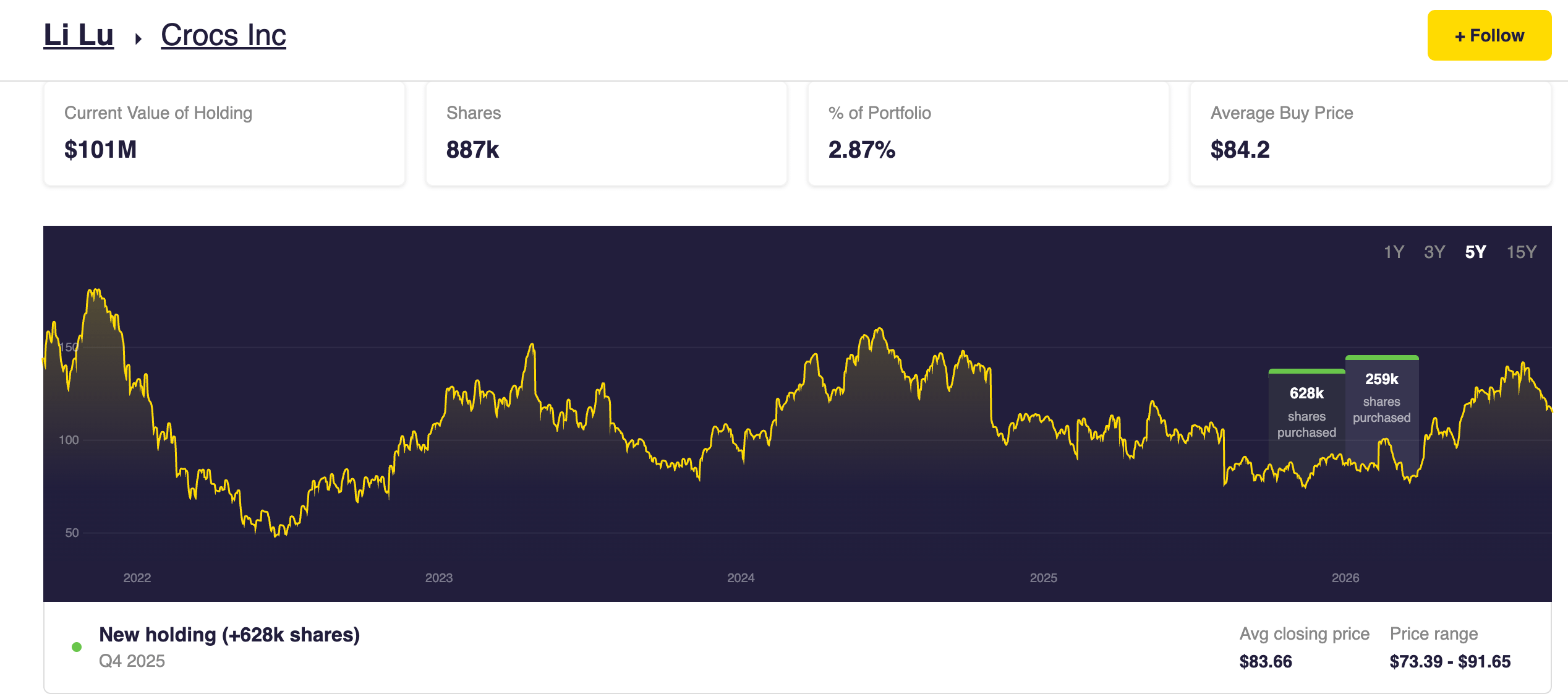
In February 2026 a filing appeared on EDGAR. Himalaya Capital Management. Li Lu’s fund. Holdings at the end of 2025. Nine positions, three and a half billion dollars, Alphabet and Berkshire and PDD.
And a new name at the bottom.
Crocs.
A clog. The most mocked shoe on earth. A brand people either love or make fun of, and both groups know exactly what it is. Tell me it is not Timberland. 🙂
Then look at what the 95 percent saw. Revenue barely growing. Tariffs eating the gross margin.
Then look at the page. The Crocs brand just did one billion dollars in a single quarter for the first time in its history. Direct to consumer up 12 percent. International up 7 percent. Twenty five percent operating margin on foam.
Then look at the price. In the first quarter of 2026 the stock fell to 73 dollars. Somewhere around six times earnings.
Five times in 1998. Six times in 2026.
What did Li Lu do? He added 41 percent. He now holds 890,000 shares.
In the second quarter he cleaned house. Sold Bank of America after six years. Sold Occidental. Sold Moody’s, S&P Global and MSCI, three positions he had opened one quarter earlier. Six exits in ninety days.
He kept the clog.
That is his page. Now the part he did not talk about in 1998 and does not talk about now. Crocs is a cannibal.
In the last quarter alone the company bought back 2.3 million of its own shares. Then the board added 1.5 billion to the authorization. Two billion dollars remains. Against roughly fifty million shares outstanding. Timberland retired eight percent of itself in a year and Li Lu made seven times. Crocs has enough authorization to retire a quarter of itself at today’s price.
He put a shitload into Timberland. Whether he puts a shitload into Crocs too remains to be seen.
So here is Part 2.

His eyes first. Is it cheap.
Then through my own cannibal’s eyes. Two billion of buybacks against fifty million shares, quarter by quarter.
The ground in Tangshan stopped moving eventually. The boy got up, walked out, and spent his whole life reading pages until he knew something the room did not.
Twenty seven years after the yellow boot he is sitting on a clog.
Maybe I’ll sit next to him.
Cheers, Sandro
Munger gave him $88 million. I’m asking for a Like. We all have our target audience. 🙂