


“I’ve seen gluts not followed by shortages, but I’ve never seen a shortage not followed by a glut.”
- Nassim Taleb
A powerful statement from a man I deeply respect. But there are forces in the modern economy that prove he may not always be right.
Let me show you one.
In 2023 I started looking at companies that make DRAM memory chips. Historically this industry had been a graveyard for investors. Brutal boom and bust cycles. New producers entered easily. They innovated, cut prices, destroyed competitors, and then the whole cycle restarted from zero.
But something changed.
The technology evolved. The chips became extremely complex. So complex that today only three companies control roughly 95 percent of the global market. Samsung, SK Hynix, and Micron. Back in 2023 these companies were hated. They traded at maybe 8 times earnings. Nobody wanted them.
Then demand exploded. Supply could not keep up. Prices rose in 2024. Climbed higher in 2025. Exploded in 2026. The only new entrant trying to break in is China’s CXMT, and for now they hold just a few percent of the market. And those three giants? They are not really competing anymore. They talk to each other. Which means they can now do almost whatever they want with pricing.
I felt this personally. I bought a new MacBook. In Europe the base model with 16GB of RAM costs around 1,500 euros. But I am an intensive user. Research, Substack, photos, video editing. I need at least 32GB. How much does that cost? Around 3,000 euros. The memory guys are effectively charging me the price of an entire second MacBook just for more RAM.
There was supposed to be a glut by now. Massive profits were supposed to attract massive new supply. That is what cyclical industries always do.
But the glut never came.
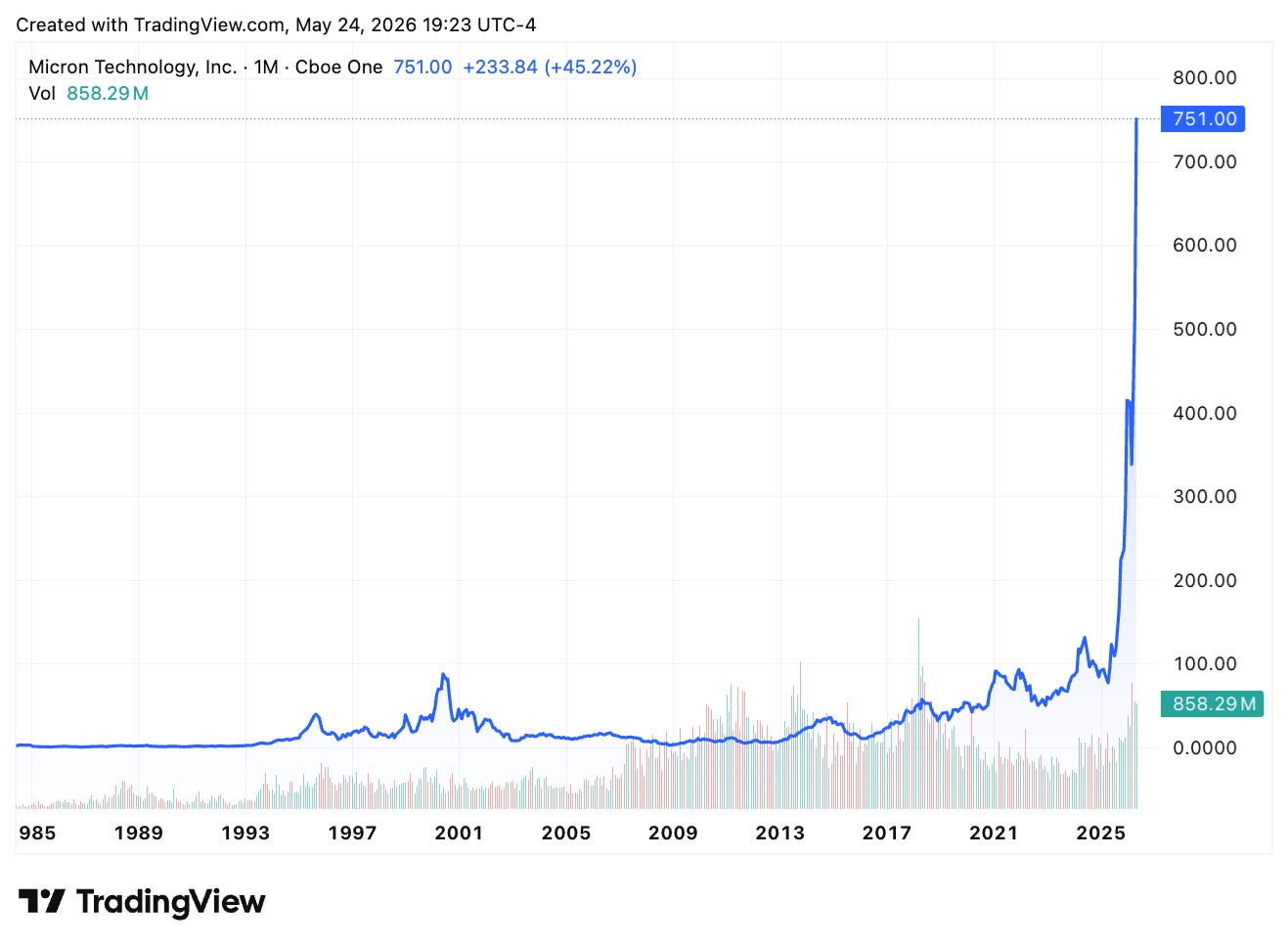
TrendForce estimates conventional DRAM contract prices rose 90–95% in 1Q26, with another 58–63% increase expected in 2Q26. At the same time, Micron stated:
“We continue to expect supply-demand conditions for both DRAM and NAND to remain tight beyond calendar 2026.”
And now ask yourself something.
What if offshore drilling and met coal are no longer normal cyclical industries either?
