


"Focusing on the price of a stock is dynamite; it really means that you think that the stock market knows more than you do. The stock market may know more than you do, but then you shouldn't be in stocks. The stock market is there to serve you, not to instruct you."
— Warren Buffett
In September of the year 2000, a man boarded a plane to Australia for a honeymoon he had postponed for far too long. He was the CEO of the hottest payments company on the internet. He owned more of it than anyone alive. And by the time his flight landed, he no longer ran it.
While he was somewhere over the Pacific, a group of his own executives gathered in a dim Palo Alto bar called Fanny & Alexander and decided he had to go. They walked into a board meeting with their case already built. The board agreed. They installed a quiet chess prodigy named Peter Thiel in his place and renamed the company. The man who got pushed out was Elon Musk, and the company that fired its largest shareholder midflight was PayPal.
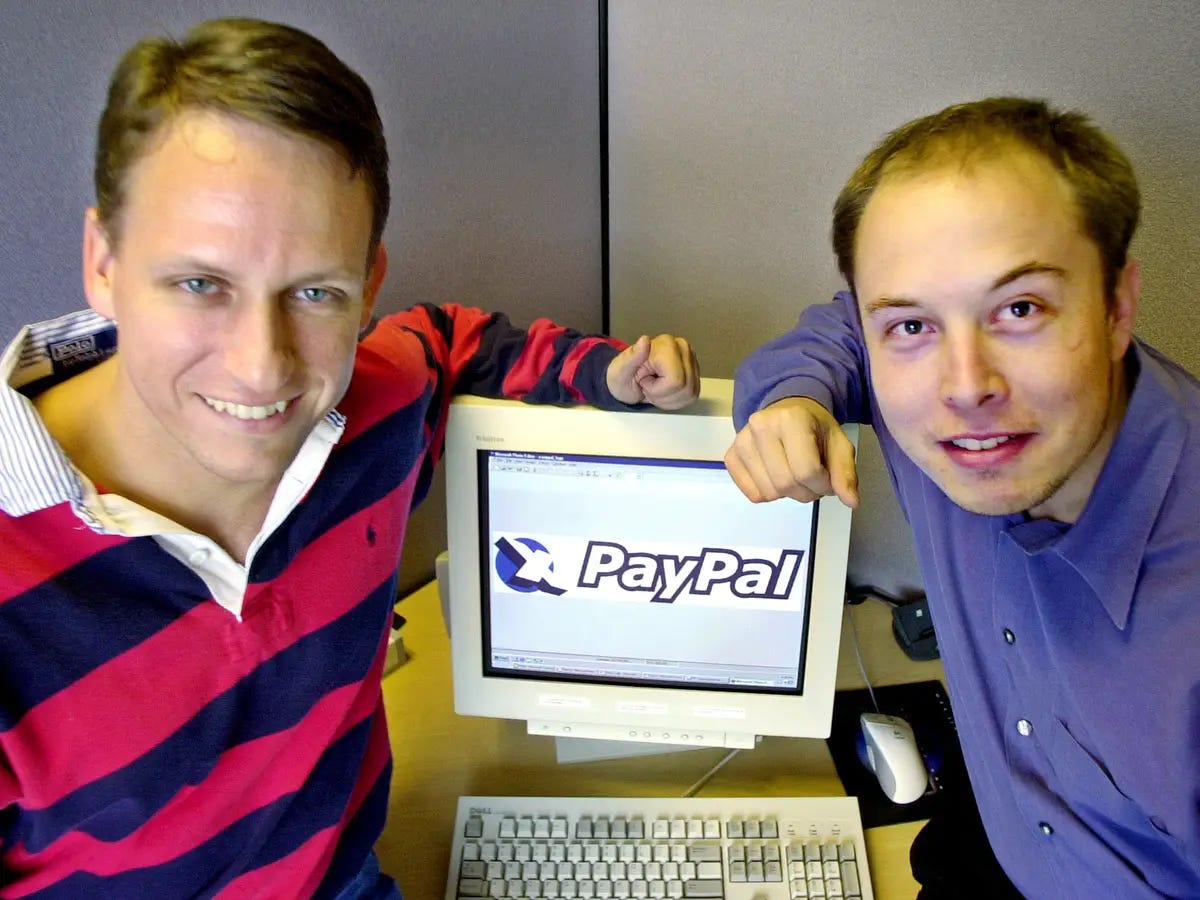
Every single person in that conspiracy went on to become a billionaire several times over. Thiel built Palantir and wrote the first big check into Facebook. Reid Hoffman built LinkedIn. The engineers down the hall built YouTube. Musk, the man they exiled, took his roughly 165 million dollars from the eBay sale and poured it into two ideas everyone told him were insane, named Tesla and SpaceX. The people who passed through PayPal’s doors in those years went on to create companies worth more than ten trillion dollars combined. They called themselves the PayPal Mafia, and they are arguably the most successful single cluster of human talent in the history of capitalism.
And the company that produced all of them?
It is the one that got left behind.
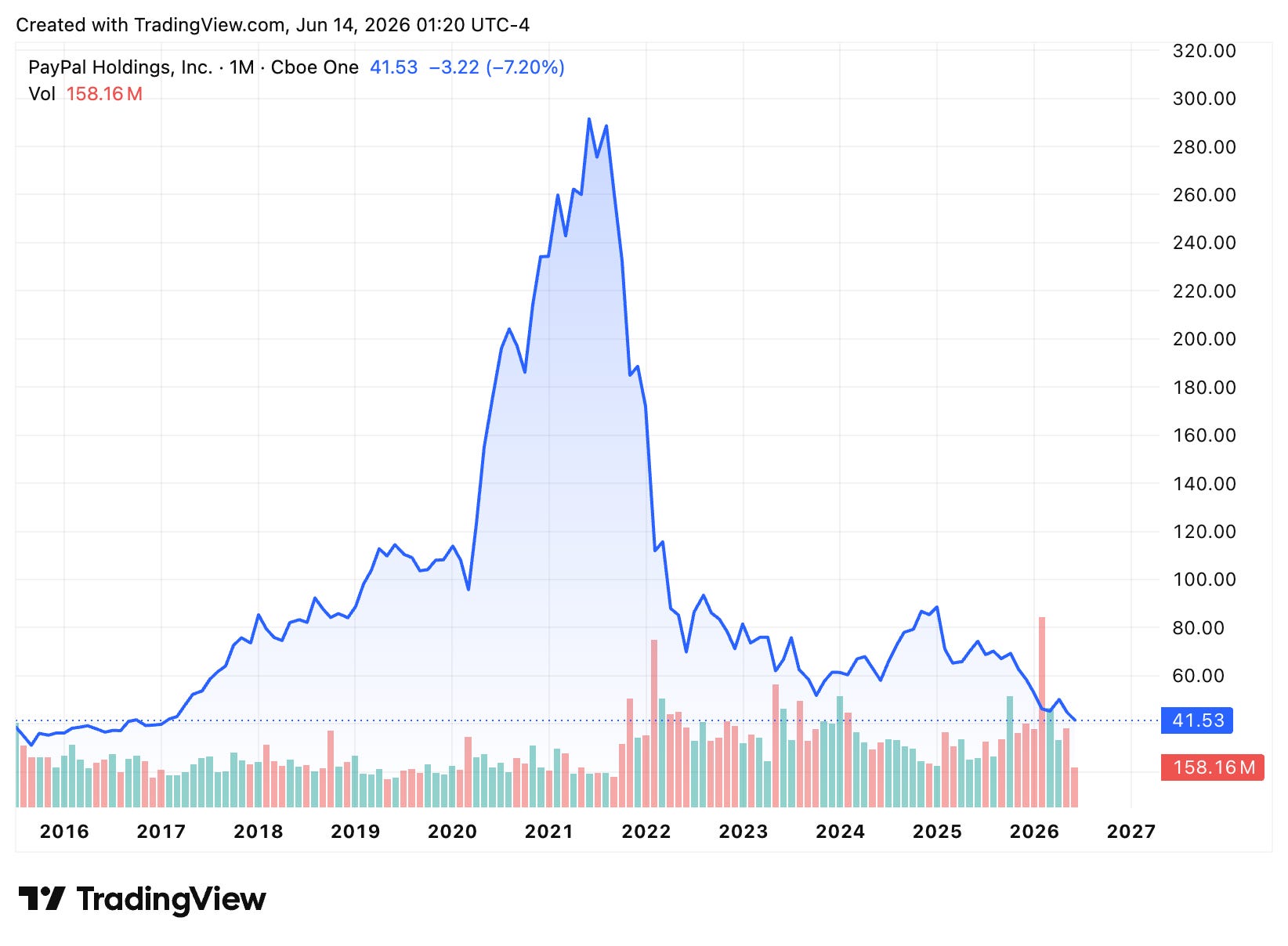
Today that same PayPal trades around 41 dollars a share. In 2021 it touched 310. The market has erased over three quarters of its value and roughly 300 billion dollars in market capitalization, more wealth vaporized than most countries produce in a year. Wall Street has written the obituary. Apple Pay is eating its lunch at checkout. The board fired its CEO this past February after just twenty eight months, midstride, the same week it admitted growth had nearly stopped. The story writes itself. The mafia got rich. The mothership is dying.
Except that is not the story.
Because while everyone was watching the stock bleed, PayPal was doing something only a handful of companies in market history have ever pulled off. As the price collapsed, management did not flinch. They kept buying their own stock. Cheaper, then cheaper, then cheaper still, spending over 100 percent of their free cash flow in some years to retire shares at prices the company had never seen as a public company. The lower the market pushed it, the harder they fired the cannon.
The effect of that is something almost nobody on financial television bothers to explain, because it is slow and boring and does not fit the death narrative. The share count is shrinking. The pie is being split among fewer and fewer owners every single year. Even a company whose profit barely moves can quietly make its remaining shareholders richer this way, and PayPal has been doing exactly that, year after year, while the market wrote its funeral. Just how powerful that math gets is the part the obituary skips, and it is the first thing I break down below.
This is the part nobody on financial television wants to explain, because it is boring and slow and it does not fit the death narrative. A company with a net cash balance sheet. A ten percent free cash flow yield. Management aiming a multibillion dollar cannon at its own shrinking float, firing it harder the lower the price falls. There is a name for a creature that consumes itself to grow stronger. There is a reason this newsletter is called what it is called.
So the question is not whether PayPal got left behind. It did. The question is whether being left behind, hated, written off, and trading at one seventh of what it once commanded is the setup for the worst value trap of the decade or the most obvious cannibal hiding in plain sight.
The man they threw off that plane understood something his executioners did not. He told a reporter years later, miming a knife being pulled from his own back, that life is too short for long grudges. He buried the hatchet and moved on to build the future.
The market just threw PayPal off the same plane.
The only thing left to figure out is where it lands.
The full breakdown is below. The buyback math the death narrative ignores. The Venmo number management buried on page nine. Why the CEO really got fired. And the single line in the 2026 guidance that tells you whether this is a trap or a gift. Upgrade to read it all.
