


In July I wrote about how Mohnish Pabrai lost about 100 million dollars on Horsehead, a zinc company that announced its own bankruptcy in public filings for eighteen months. I learned more from that post than from any success story I have studied. A winner can explain his win any way he likes afterwards. A loss of that size leaves filings, dates and prices behind, and every step can be checked. So I am staying with the mistakes of great investors, and this one is ten times bigger.

It is also a mistake Pabrai could never have made, because betting against a company is something he has refused to do his whole life. When Steve Forbes asked him about short selling, he answered with a question of his own. Why take a bet, he asked, where
“your maximum upside is a double and your maximum downside is bankruptcy?”
A short pays out in full only on the day the company goes to zero. On the other side there is no ceiling, because a share price can rise for as long as somebody is willing to buy. Seven years later he told an audience at Google how seriously he meant it.
“I will go to my grave without ever having shorted a stock.”
Charlie Munger stayed away for a simpler reason. He once described what it is like to be short while a promoter takes the stock up, and where that left him.
“It’s not worth it to have that much irritation in your life.”
On October 28 Bill Ackman sat across from Nicolai Tangen, the man who runs Norway’s oil fund, and told the story of the promoter who took his stock up. Carl Icahn, he said, did no work on the business and simply figured he could squeeze him. Tangen then asked what people have wanted to ask Ackman for eight years.
“And you lost a billion?”
“We did.”
Pershing Square never put a dollar figure on Herbalife in any letter to its investors. Its founder now has.
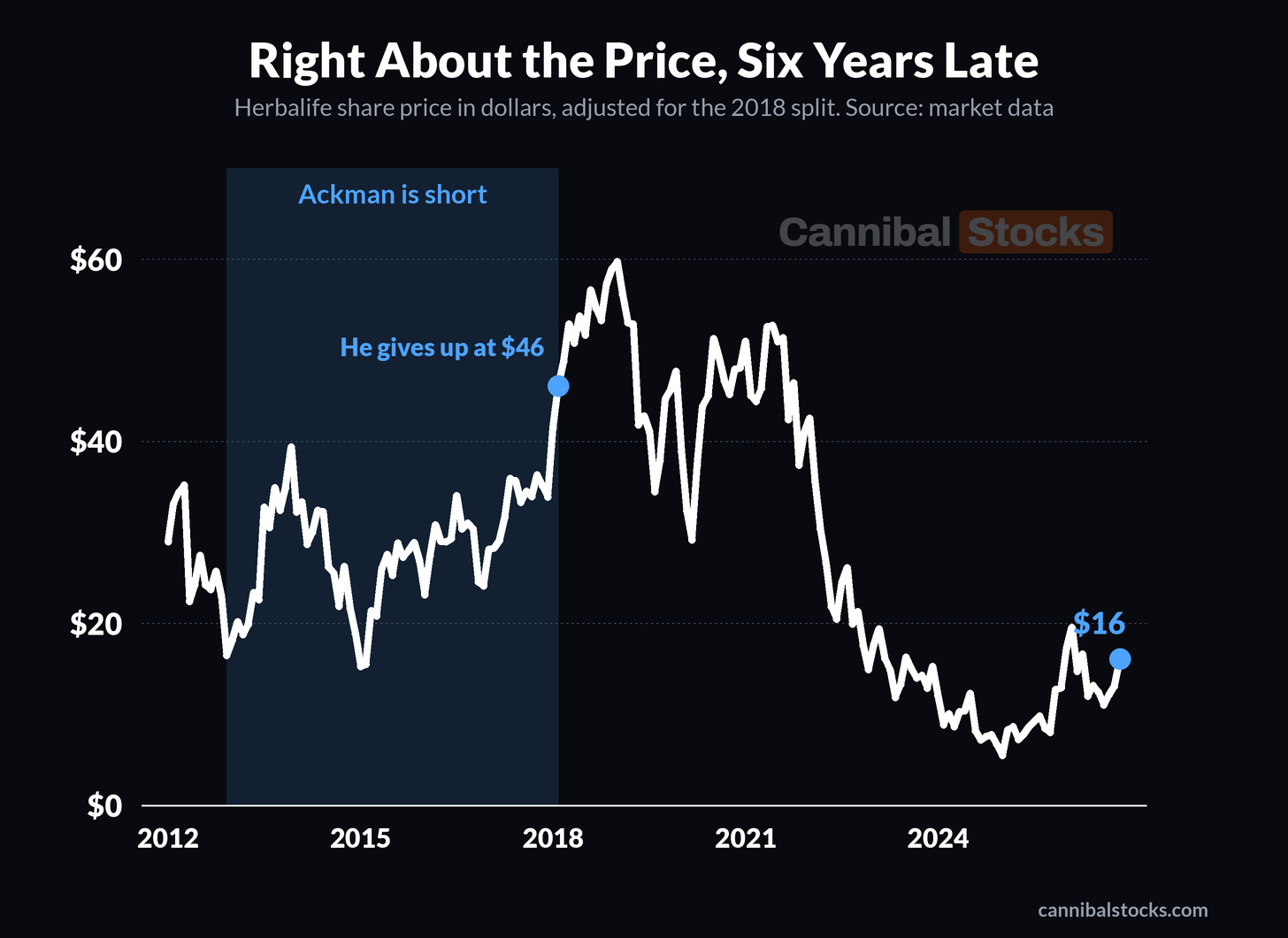
The Federal Trade Commission ended up agreeing with most of what Ackman said about the company. Herbalife shares trade about two thirds below the price at which he gave up. He was right about the business, he was right about where the stock would end, and he lost a billion dollars. I went back through fourteen years of filings to put the whole thing in order, date by date.
The bet
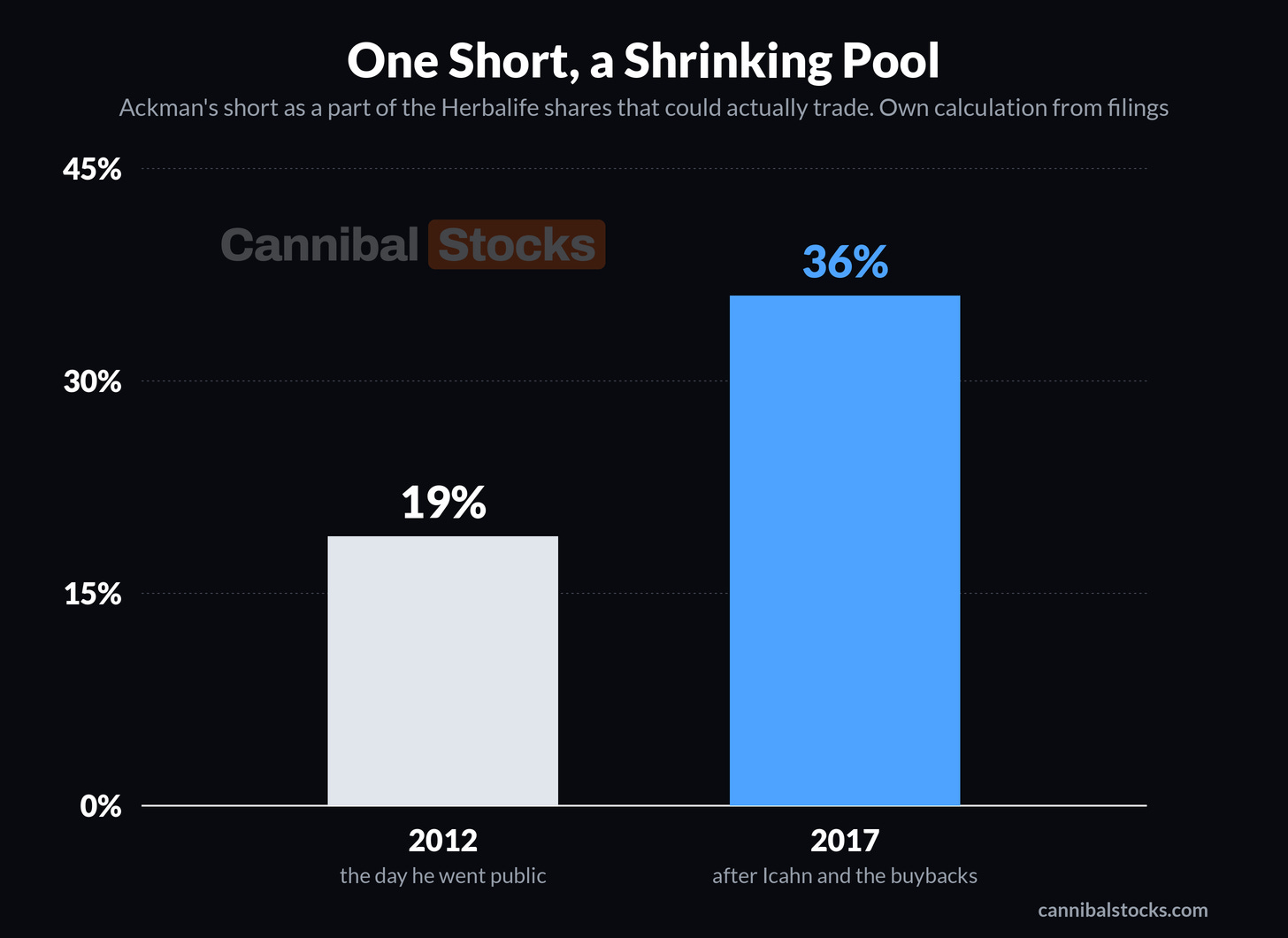
December 19, 2012, New York, two in the afternoon. CNBC reports that Bill Ackman is short Herbalife. The stock drops ten percent in six seconds and trading is halted. He has sold more than 20 million shares he does not own, about a billion dollars’ worth, close to one share in every five that exist.
December 20, 2012. In a 500 seat auditorium in Manhattan, Ackman stands in front of 342 slides for three and a half hours. The deck is called “Who Wants to Be a Millionaire?” and his target price is zero. He calls Herbalife “the best-managed pyramid scheme in the history of the world”. In 2011, he shows, the company paid 88 percent of its distributors nothing, and the money went to the people who recruited new sellers. He promises to give his own profits to charity and calls them blood money.
He could have stayed quiet. But a profitable company does not go to zero by itself. Somebody has to close it, and regulators only move when there is noise. That noise had a price, because from this morning on everybody in the market knew that one fund would one day have to buy back 20 million shares. And five months earlier Herbalife had finished buying 9.2 million of its own shares and approved another billion dollars of repurchases.
December 24, 2012. The stock has gone from 42 dollars to 24 in a week. Herbalife split its shares two for one in 2018, so in today’s prices that is 21 to 12. Ackman is ahead by more than 300 million on paper. Herbalife will never trade this low again while he is short.
January 2013. Dan Loeb appears with 8 percent of the company. He calls the pyramid claim preposterous and sells everything within three months for about 50 million dollars of profit. He was betting on the 20 million shares Ackman would one day have to buy back, not on the business.
2003, ten years earlier. Ackman, short of cash, sells Carl Icahn a stake in a company called Hallwood at 80 dollars a share. The contract has a clause Icahn himself named “schmuck insurance”. If Icahn sells within three years, Ackman gets half of the profit. Thirteen months later Hallwood is bought for 136 dollars. Icahn refuses to pay the 4.5 million. Ackman sues and, after years of appeals, wins. Icahn calls to congratulate him. Ackman says he answered with some fairly strong words.
January 25, 2013. Ackman is on CNBC by phone. Icahn calls in. For 27 minutes, live, two billionaires shout at each other.
“He’s like the crybaby in the schoolyard.”
“I wouldn’t invest with you if you were the last man on Earth.”
And then Icahn says what he is going to do.
“This could be the mother of all short squeezes.”
February 2013. Icahn files for 13 percent of Herbalife. By May he has 16.5 percent and two board seats. He will end up with five seats and a quarter of the company. Every share Icahn owns is a share Ackman can neither borrow nor buy.
September 2013. Bill Stiritz, who built Energizer with debt and buybacks long before anyone called such companies cannibals, puts 322 million dollars of his own money into 5 percent. He tells a reporter there are two ways to deal with a short seller. One is a quick bite. The other, in his words,
“you can have an all-day sucker where you shrink the shares slowly over time.”
George Soros takes another 5 percent.
At the end of 2012 Herbalife had about 107 million shares. During 2013 Icahn took almost 17 million of them off the market and the company retired more. The share count fell only 5 percent that year. The number of shares a short seller could actually borrow fell 21 percent, because Icahn was never going to lend his. Ackman added no shares, and his short still grew as a part of what was left.
October 2013. Herbalife is on its way to a gain of 138 percent for the year. Forbes estimates that Ackman is half a billion dollars behind. He buys back 40 percent of the short and replaces it with put options. That caps his loss, but now he has to be right before the options expire.
The company borrows to eat itself
February 2014. Herbalife sells 1.15 billion dollars of convertible notes at 2 percent interest. Before the money has settled, 686 million of it goes into buying 9.9 million of its own shares. Two months later the board ends the dividend and says the cash will go to buybacks. At the end of 2013 Herbalife had more cash than debt. Twelve months later it owes 1.2 billion net. For Icahn’s people on the board the sum is easy. Money costs 2 percent, and every share that disappears makes Ackman’s problem bigger.
March 2014. Ackman fights with what he has left. He spends 50 million dollars investigating the company, hires lobbyists and gets members of Congress to write to regulators. That month the FTC opens a formal investigation, and the stock falls 52 percent that year. In 2015 it rises 42 percent again, while Valeant is blowing up the rest of his fund.
July 15, 2016. The FTC settles. Herbalife pays 200 million dollars and must rebuild its American pay system around verifiable sales. Its press release says it was not found to be a pyramid scheme. That afternoon the FTC chairwoman, Edith Ramirez, is asked about it.
“They were not determined not to have been a pyramid.”
The stock rises ten percent that day. The regulator had described the business almost the way Ackman did, and then fined it instead of closing it. His short only worked if Herbalife was closed. On the same afternoon the board raised the limit on Icahn’s ownership from 25 to 35 percent.
2017. Herbalife borrows another 1.3 billion dollars and offers to buy 600 million dollars of its own stock. Icahn sells nothing. His stake goes from 24 to 26 percent without him spending a dollar, because the company buys out the people around him. This is from Pershing’s annual report for that year.
“We underestimated Herbalife’s ability to access debt capital and use financial engineering”
February 28, 2018. Ackman has already bought back the last of the shares and holds only puts. He tells CNBC he is all but out. Herbalife closes that day at a record high. The next morning Icahn goes on the same channel.
“I enjoy a good fight, especially when I win it.”
On paper, Icahn says, he has made a billion. Four years later one line in Pershing’s annual letter ends the chapter. The firm has “permanently retired from this line of work”.
What the cannibal did next
January 2021. Herbalife borrows 600 million dollars and buys Icahn’s shares at 48.05 each. He resigns his board seats and is gone by May.
2022 to 2025. Sales fall ten percent in 2022. Profit falls by a third in two years. The debt stays the same and still climbs from two and a half times earnings to three and a half. In April 2024 it refinances 800 million dollars at 12.25 percent, ten years after it borrowed at 2. On February 15, 2024 the stock falls 32 percent in one day, and Ackman posts that it is a very good day for his psychological short. In the spring of 2025 it touches five dollars.
November 2026. The stock is at about 16 dollars. Between 2012 and 2021 Herbalife spent 5.7 billion dollars on its own shares. At today’s price those shares are worth about 1.8 billion. The stake it bought from Icahn for 600 million would cost about 200 million now.
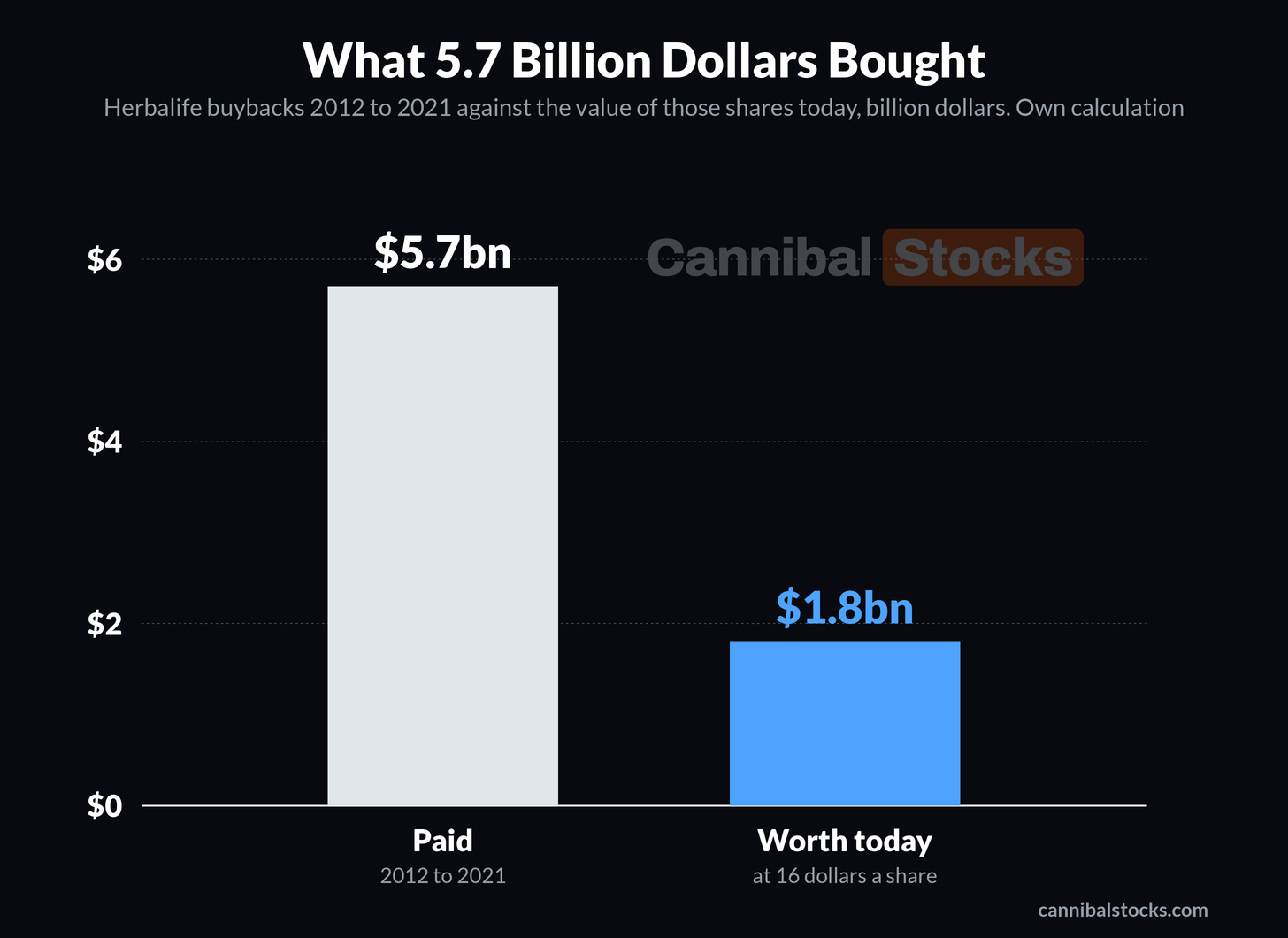
So was Ackman right in the end? On the price he was, six years after he left and for a reason that was never on his 342 slides. It never fell apart as a pyramid, and its sales in 2025 were higher than in 2017. What fell apart was a company that had stopped growing and still carried the debt it took on to beat him. Anyone who held the short from 2012 to the peak in 2019 was down almost 190 percent on paper before the stock ever turned.
Ackman shorted a company that made cash, could borrow at 2 percent and had a shareholder on its board who wanted as few shares out as possible. Then he told it exactly how many shares he would have to buy.
Of the three, only Icahn left with money, and he got it from the company. I own companies that buy back their own shares, so that is the scene I keep coming back to. Those buybacks beat Ackman, and they were paid for with debt at prices three times today’s. The shareholders who stayed have been paying the interest ever since, lately at 12.25 percent.
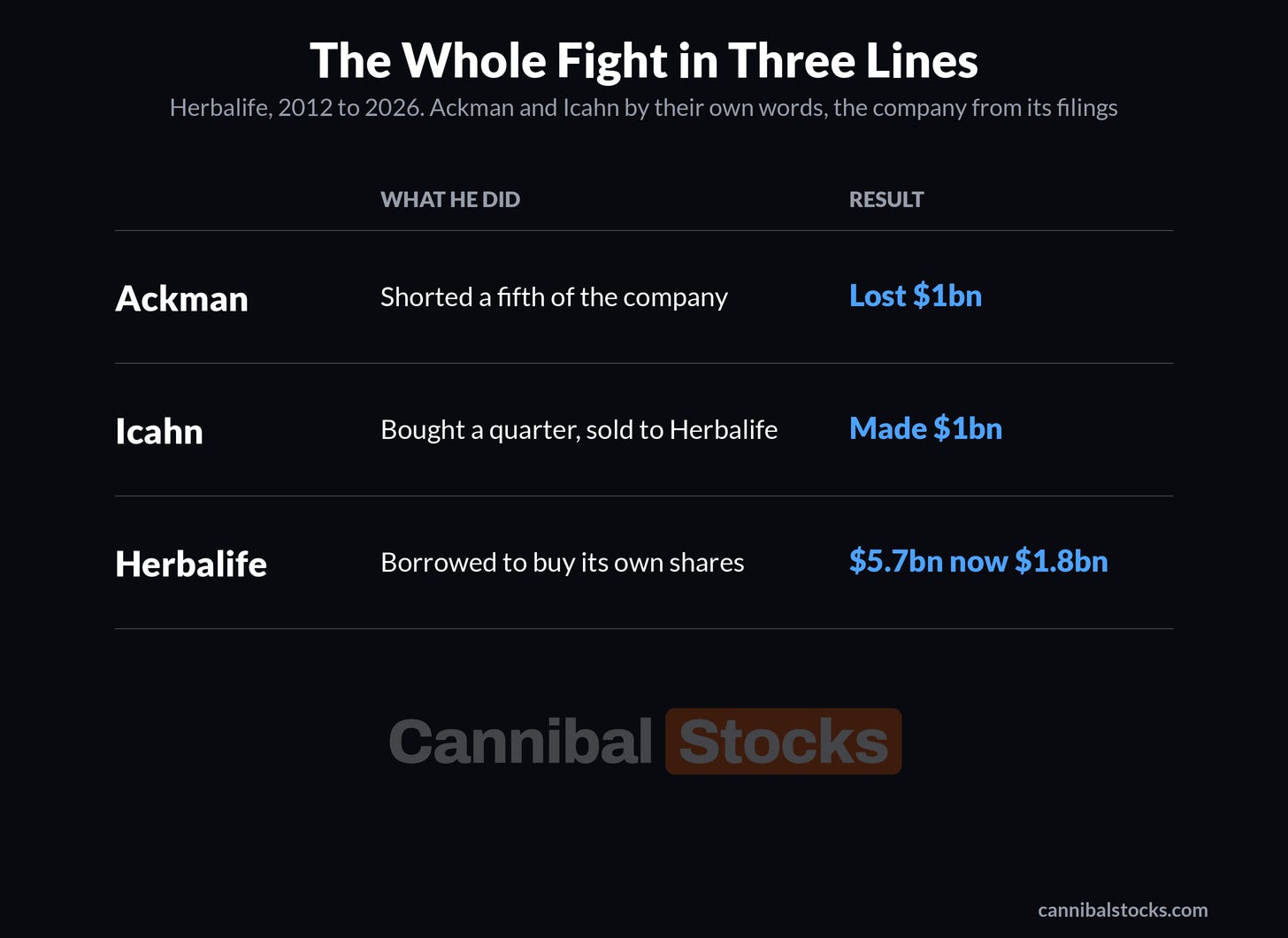
Pabrai’s arithmetic says a short can at most double. Ackman’s bet was about a billion dollars, so the most it could ever have paid him was about a billion, on the day Herbalife reached zero. He lost that amount on a stock that never got there.
It is at 16 dollars now. The CEO left on October 31 and went back to his own network of nearly 700,000 distributors. On September 8 the board approved 250 million dollars of new buybacks, about 15 percent of what the whole company is worth, with a balance sheet that shows a shareholders’ deficit. Icahn has been gone since 2021 and Ackman since 2018. Herbalife is buying again.
Cheers, Sandro
Like and restack. If you unsubscribe, I will borrow money at 12.25 percent and buy you back.🙂
Next.
“Housing will come back – you can be sure of that.”
Warren Buffett, 2011
Fifteen years later Berkshire spent $595 million in eleven days on a homebuilder that eleven analysts rate a sell. It now owns 12% of Lennar. I spent a week finding out why, and what a short seller found on the day the buying stopped.
Lennar deep dive, part 1. Coming soon…
Shorting a company that keeps buying back its own shares means fighting the one buyer that never gets a margin call. The Herbalife lesson is that being right about the business doesn't help if the float keeps shrinking under you.
Ackman was mostly right about the business and still lost a billion dollars. A company that can borrow at 2 percent and buy back its own shares is a different opponent than a company that is simply overvalued. Being right about the business was not the same as being right about the structure around it.