


Google his name. Go ahead. Try to find a photo.
You will find two. Maybe three. That is it. No Twitter account. No LinkedIn. Nothing.
This man built a 300-bagger. And the world has almost no idea what he looks like.
His name is Mark Leonard. He is the founder of Constellation Software. He took the company public in 2006 at 17 dollars a share. By May 2025 that share was worth 5,300 dollars. A 34% annual return for nearly two decades. One of the greatest track records in stock market history.
Then the stock crashed 50%.
Today it trades around 2,300 dollars. And even after that crash it is still up 140 times from the IPO. Most investors would kill for a 10-bagger in their lifetime. Leonard delivered 140. After the crash.
This story is about the man. And about what he built. And about what happens next.


The Terrible Banker
Leonard started his career as an intern at Barclays. A mentor pulled him aside early and said something that would change his life.
“You are going to make a terrible banker.”
The mentor told him to go study the firm’s clients. Find something else. Anything else.
So Leonard wandered into venture capital. And there he met a man named Steve Scotchmer. An advanced materials engineer who had successfully built and run his own business. They searched together for a company that Leonard could invest in and Scotchmer could run.
They never found one.
Scotchmer’s bar for quality was impossibly high. Nothing met his standard. But something more important happened during that search. Scotchmer became Leonard’s mentor. He fed him Buffett. He fed him Munger. He taught him what a truly great business looks like.
Leonard went back through his venture firm’s portfolio with fresh eyes. And he zeroed in on a category of business that checked every single box.
Except one. They were too small to matter on their own.
The Dentist’s Secret
Think about your dentist.
When you walk in the door there is software running the entire practice. Appointments. Patient records. X-rays. Billing. Insurance claims. Every single part of the operation.
That software was not built by Microsoft. It was not built by Google. It was built by a tiny company you have never heard of. A company that spent 20 years sitting next to dentists learning exactly what they need. Tweaking. Adjusting. Customizing. Building trust that took decades to earn.
That is vertical market software. VMS for short. One product. One niche. One deep relationship. Leonard described it in a single sentence that explains his entire empire.
“Vertical market software is the distillation of a conversation between a vendor and the customer that has gone on frequently for decades.”
Now think about the economics of that business.
The dentist is not switching. Ever. The software runs everything. Switching would mean weeks of chaos. Retraining staff. Losing data. Risking patient records. And for what? The software costs less than one percent of the practice’s revenue. The dentist does not even think about it.
Constellation retains somewhere in the mid 90s percent of its customers every single year. The average customer relationship lasts 20 to 30 years. The margins are high. The revenue is recurring. The capital requirements are low. And here is the part that really got Leonard excited. These markets are tiny. So tiny that there are usually only two or three players. Nobody else wants in. The addressable market is too small to attract big money.
Venture capital does not care about a 5 million dollar software company that runs bowling alleys. Private equity is not interested.
But Leonard was.
He found the one flaw. These businesses were incredible. But they were small. They could not absorb much capital individually.
So he came up with an idea. What if you did not just buy one? What if you bought hundreds?
The Machine That Never Stops
In 1995 Leonard raised 25 million dollars. Mostly from pension funds. He built a holding company called Constellation Software. And he started buying. The rules were simple. Buy vertical market software companies. Buy them directly from founders whenever possible. Pay fair prices. Never sell.
Take the cash flow. Buy more. Rinse and repeat. For 30 years.
Today Constellation owns more than 600 of these businesses. They have sold exactly one. Leonard still regrets it. The typical deal is 3.3 million dollars. These are companies so small they are invisible to the rest of the financial world. But inside each one is a machine that prints sticky recurring revenue from customers who will never leave.
And the supply of deals is endless. Some estimates put the total number of vertical software companies worldwide at 70,000. Constellation contacts them at least twice a year. They have a large team making phone calls and sending emails to founders. The message is always the same. If you ever decide to sell please think of us.
Most of these founders are between 40 and 80 years old. Every year a few percent want to retire. Others want to move on. Some need the cash yesterday. That means thousands of potential deals flowing into the pipeline every single year without Constellation having to chase anything. About half of revenue comes from government agencies. Free cash flow has compounded at 26 percent annually since the IPO.
What separates Constellation from every other software company? This is clean free cash flow. Real cash. No stock based compensation tricks. No adjusted metrics. Constellation pays its people in actual money. When you see a software company reporting 20 percent free cash flow margins remember that most of them are hiding massive equity compensation costs. Constellation is not hiding anything.
So why has nobody replicated this? After 600 acquisitions Constellation has a proprietary dataset that tells them exactly what a broken software company is worth and exactly how to fix it. They win the deals nobody else wants because nobody else has the pattern recognition. Add 30 years of reputation as a permanent home for founders and you have a moat that gets wider with every deal they close.
The Anti-CEO
Now let me tell you about the man himself. Because this is where it gets strange.
Leonard asked for his salary to be reduced to zero. Then he stopped taking a bonus. Then he started paying his own travel expenses. He explained that he used to fly economy and stay in cheap hotels because he did not want to freeload on Constellation’s shareholders. But as he got older and wealthier he wanted more comfortable travel. So instead of charging first class to the company he just paid for it himself.
More than 100 employees owned over a million dollars in Constellation stock by 2015. Leonard wanted that number to grow five times by 2025. Every employee above a certain pay threshold must invest 25 to 75 percent of their after-tax bonus into Constellation shares. Those shares are locked up for four years. More than 3,000 employees participate. Insiders today own nearly 1.5 million shares worth about 2.6 billion dollars.
There is no stock based compensation. The share count has barely moved since the IPO. Zero dilution.
Here is a story that tells you exactly who this man is.
In 2011 Constellation’s two private equity sponsors wanted out. To find buyers and keep the company independent Leonard made a personal guarantee. If Constellation did not compound at least 10 percent per year he would transfer a portion of his own shares to the buyer.
His own shares. Out of his own pocket.
It was never necessary. But the fact that he offered tells you everything.
He considers his second capital raise in 1999 one of his biggest failures. They did not need the money. They raised it just to diversify the investor base. The dilution was permanent. It has cost shareholders billions. It was the last time Constellation ever issued equity.
The stock kept going up anyway.
And about buybacks? Leonard has moral reservations. He believes management has more information than selling shareholders. His securities counsel told him that directors cannot legally do buybacks while holding material undisclosed information. To reveal enough to make buybacks legal would mean exposing trade secrets. That would hurt long-term shareholders more than the buybacks would help.
So he simply does not do them.
This is not a man playing the Wall Street game. This is a man playing a completely different game. And winning.
The Crash
On a Tuesday morning in September 2025 Constellation Software released a short statement. Mark Leonard was stepping down as President due to health issues. Effective immediately.
Thirty years. Gone in a press release.
His replacement was Mark Miller. One of the founders of the very first company Constellation ever acquired back in the 1990s. A man who had been inside the machine since day one. If anyone understood the culture it was him.
But the market did not care about culture. The market cared about one thing. The man who had compounded capital at 34 percent a year for three decades was no longer running the show.
Then in March 2026 Leonard announced he would not stand for re-election to the board. His last day would be May 15. The founder was not just stepping back. He was stepping out.
At the same time a wave of panic swept through every software company on the planet. Artificial intelligence was going to change everything. The narrative was simple and brutal. Why would anyone pay for niche software when AI could build a custom replacement in minutes?
Constellation fell 50 percent. From 5,300 dollars to 2,300. Billions in market value gone. Other software names fell 70 percent or more.
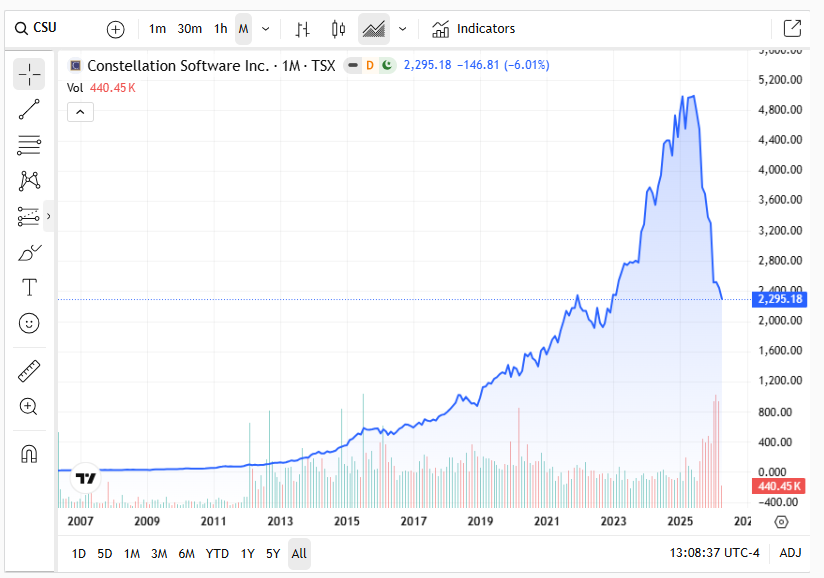
Thirty years of compounding. And half of it erased in months.
Now here is where most people stop thinking. The stock is down. The founder is gone. AI is coming. Sell everything.
But stop for a second.
Before he left Leonard addressed the AI question directly. He told the story of a prediction made years ago by an AI specialist who said artificial intelligence would eliminate radiologists. The specialist told young people to stop studying radiology entirely.
Over the following decade the number of radiologists grew 17 percent. Most of them are thriving. AI did not kill the profession. It made radiologists faster and more accurate.
Now think about what Constellation actually owns. These are not generic consumer apps. These are systems that run hospitals. That manage water treatment plants. That operate transit authorities and courts and schools. Systems built through decades of conversation with customers who depend on them every single day.
Your dentist is not going to ask an AI to rebuild the software that manages patient records and insurance claims and appointment schedules and regulatory compliance across three jurisdictions. Not this year. Not in five years. Probably not ever.
Will some of Constellation’s thousand-plus subsidiaries feel pressure from AI? Of course. But AI is far more likely to become a tool inside these products than a replacement for them. The same way it became a tool for radiologists instead of a replacement.
Constellation now trades below 15 times free cash flow. The cheapest it has been since 2014. For most of the last decade the market valued it between 25 and 30 times.
The greatest compounding machine in Canadian stock market history. At a decade-low valuation.
The Question
Can this machine keep running without the man who built it?
Here is what gives me confidence. Leonard spent 30 years making himself unnecessary. The decentralized structure was not an accident. It was the plan. Six operating groups run independently. Capital allocation decisions are pushed down to the people closest to the deals. The incentive systems are locked in. Over 3,000 employees own the stock. The playbook is not in Leonard’s head. It is in the culture.
But I will not lie to you. Losing a founder of this caliber is never nothing. Buffett is 93 and Berkshire investors still get nervous. Leonard is 66. He is stepping away not dying. There is a difference. But it is the biggest transition in Constellation’s history and the market is right to ask hard questions.
Here is what I think.
Constellation Software is one of the greatest compounding machines ever built. Mark Leonard is one of the most underrated capital allocators alive. The model is proven. The culture is deep. The track record is 140 times your money even after a 50 percent crash.
But at 50 billion CAD I think I am too late. The 140-bagger already happened. I am not here to buy what already compounded. I am here to find what is about to.
And that brings me to a new idea.
“Pay special attention to cannibals, cloners, and spin-offs.”
That is Charlie Munger’s advice.
Constellation spun off two companies. Most people know about Topicus. But there is another one. Smaller, less known, and with a growing presence in Europe.
A company born directly from Constellation’s DNA. Same playbook. Same incentive structure. Same acquisition discipline. But smaller. Much smaller. Thirty businesses today versus six hundred. A CEO who is in active conversation with hundreds of founders. A pipeline of over a thousand targets. And Constellation still holds 60 percent of the equity.
Mark Leonard said one thing about this company that stopped me cold.
“I hope my grandkids are still holding Lumine shares 50 years from now.”
Read that again.
This is the man who built a 140-bagger. A man so careful with words that he writes one shareholder letter a year and says almost nothing in public. He has never said anything like this about any other company. Not even Constellation itself.
I spent the last few weeks inside Lumine’s filings. The acquisition math. The capital allocation. The management incentives. The runway ahead. What I found changes how I think about this entire sector.
That deep dive is for paid subscribers.
If you want to see what I see, the link is below. And if you enjoyed this piece, give it a like and restack. I write about stocks nobody has heard of, so this is basically my only chance of convincing the algorithm I exist. 😅
Cheers, Sandro

Great read as usual, Sandro. I didn’t know your expertise extended into software!
A couple of points:
1. Valuation: CSU trades at 3.3x P/Sales, or at levels last seen in 2012-13, whereas it’s been as high as 8x in the recent past. You ascribe much of this de-rating to market misconceptions about governance and misplaced fears about AI. However, I would note that ROIC has dropped from the high thirties % to 7% in 2025. I haven’t done the analysis but I would guess this low recent figure is more about below-the-line extraordinary items given that gross margin stayed roughly stable & EBITDA margin rose over the period. Were there write downs, eg of goodwill? Can you hazard an estimate of future ROIC in 3-4 years?
2. Technicals: FWIW, I use LT technicals to time entries and exits. CSU is sitting on horizontal resistance/support last tested in late 2021 and early 2023. It is also at the bottom of a (very tentatively-drawn) channel dating back to 2013. Finally, the weekly RSI failed to confirm the latest dip down, which occurred on somewhat weak volume. I would need to see recovery and confirmation from other preferred indicators before moving ahead on this but I think on balance it will be a lot higher on a 5-year view and I will be looking to buy based on the thesis you set out.
Thanks!