


The last drillship the world will ever build has probably already been built. Her name is Deepwater Aquila. She was ordered in late 2013, sat unfinished in a Korean yard through the entire downturn, and was finally delivered in late 2023. A billion dollar machine that took a decade to reach the water.
Since the mid 2010s, not a single new drillship has been ordered anywhere in the world. Not one. In a decade.
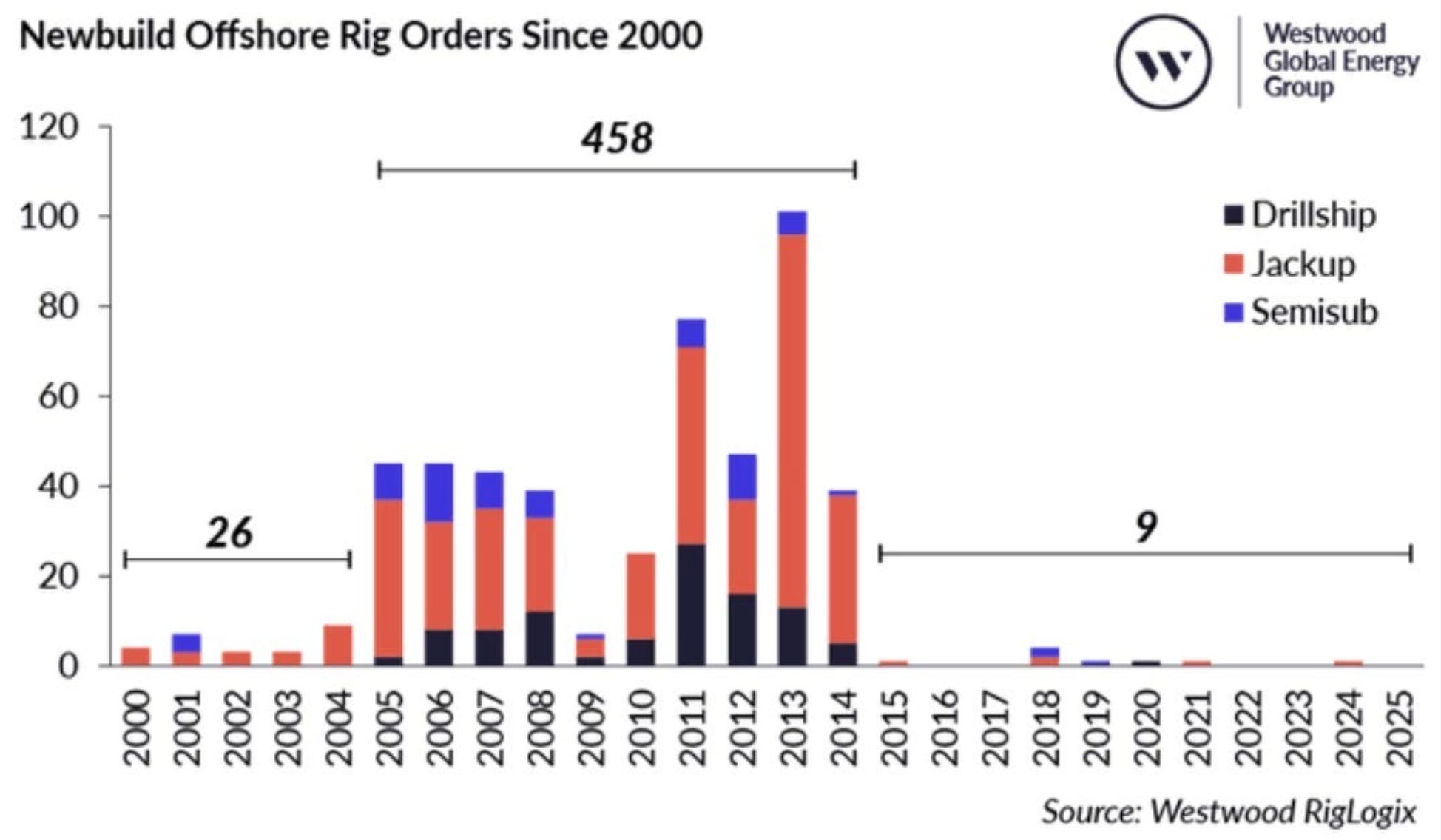
Now hold that thought, because the world did not stop needing these machines. It needs them more than ever. A fixed fleet meeting rising demand. That collision is the whole story of this post.
Most people carry a picture in their head from 2014. Deepwater oil is the expensive stuff, the first thing that dies in a downturn. That picture is upside down today.
Deepwater is now the cheapest oil on the planet. Well, except for a few fields in Saudi Arabia, where the oil practically pumps itself out of the ground. Guyana produces at a breakeven around 23 dollars a barrel. Namibia sits near 20. Brazil’s pre salt runs about 35. Exxon says most of its deepwater projects earn ten percent returns at 35 dollar oil. US shale needs 56 to 66. The oil three kilometers under the ocean is now cheaper to produce than the oil under Texas. A decade of brutal discipline did that. The downturn killed every weak project, and what survived only drills the best rock on earth.
So the cheapest barrels left are under deep water. And to reach them you need one specific machine. A drillship. A new one costs 1 to 1.2 billion dollars, and here is why nobody orders one.
To earn back a billion dollars, a new drillship needs day rates around 800 thousand dollars, sustained for at least a decade. Today’s rates are 400 to 500 thousand. Whoever builds one today volunteers to lose money for a decade. So nobody volunteers. And even if someone wanted to, the banks left the sector after the last crash, the shipyards are full of LNG carriers for years, and the engineers have retired. The factory itself has been dismantled.
So even at 120 dollar oil, the first new drillship would not touch water for the better part of a decade. For all practical purposes, the fleet is fixed. About 97 drillships exist on earth. That is the supply. It is very likely the maximum supply the world will ever have. From here, the fleet only gets older and, eventually, smaller.
There is one small cushion. During the downturn, owners cold stacked rigs, parked them and shut them down. About 13 drillships and 17 semisubmersibles are sleeping like this today. Waking one costs 85 to 90 million dollars and takes over a year, and no owner does it without a long contract already signed, usually with the customer paying part of the bill upfront. Once those ships are back at work, there is nothing behind them. No newbuilds. No plan B. Nothing.
But honestly, all of that is the easy half of the thesis. Fixed supply was just as true in 2021, and everyone who bought on that idea alone spent three years waiting and doubting. The difference between 2021 and today comes down to one question. Where does the cycle clock stand right now. Demand moves first, then day rates, then asset values, in that exact order, every time. Read the clock right and you know what comes next before the market prices it.
I am not writing this from the sidelines. I own these stocks, and they are among the largest positions in my portfolio. Below the paywall is exactly why, where we are on the clock, and the two risks that could still prove me wrong. Including the single most important paragraph I have written about offshore.
