


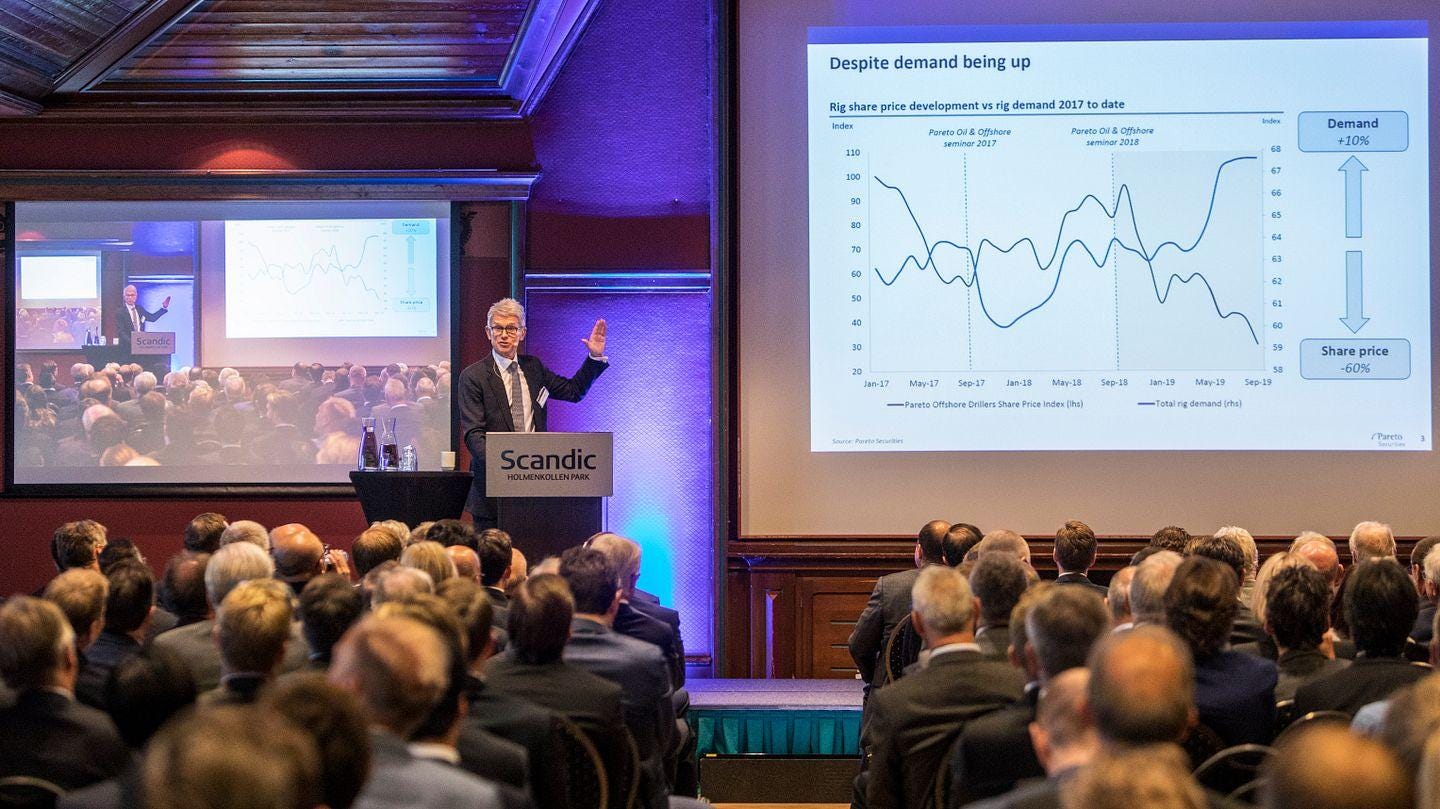
Every September, the Norwegian bank Pareto Securities hosts the largest energy conference in Europe. This year it was in Oslo on September 16 and 17. More than 160 companies presented and around 2,000 people attended. The people who own the drilling rigs, the oil companies that rent them, and the investors who finance both sit in one building for two days. If you want to know where offshore oil is heading, this is one of the best signals you get all year.
It also happened in a strange week. Brent crude went above $109 because tankers are being attacked in the Persian Gulf and the Strait of Hormuz is half closed. Offshore oil, drilled from floating rigs off Brazil, Africa, Norway and the Gulf of Mexico, does not pass through Hormuz. When the Gulf is blocked, this is the oil the world falls back on.
1. First, what a rig-year is
A quick explanation.
Offshore rigs come in two kinds that matter here. Drillships, which work in very deep water off Brazil and Africa. Harsh environment semis, floating platforms that work in the rough water off Norway. Both are rented by the day, and the price is called a dayrate. A good drillship today earns around $450,000 a day.
When an oil company signs a contract, the industry counts it in rig-years. One rig, one year of work, one rig-year. If you add up all the contracts signed in a year, you get a picture of how much work the customers actually committed to. Not what they said on a panel. What they signed.
That number is the most important thing that came out of Oslo.
2. The customers came back
Transocean showed a chart I have not seen anywhere else. Floater rig-years awarded worldwide, by year.
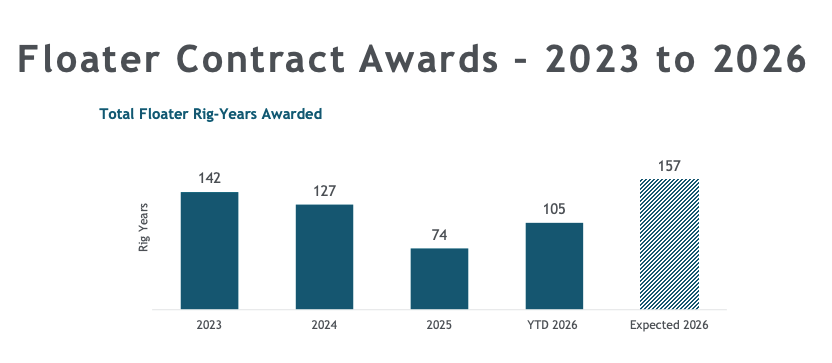
Last year the offshore recovery nearly stalled. Customers stopped signing.
Then this year. By September 1, oil companies had already committed to 105 rig-years. That is 42 percent more than all of 2025, with four months still to go. Transocean, using S&P Petrodata, expects the full year to reach 157. That would be the strongest contracting year of the whole cycle, stronger than 2023.
The 105 is a fact. The 157 is a forecast, and rig companies tend to be optimistic. But even if the year ends at 130, the message is the same. Demand is back.
3. The contracts are getting longer
Fifty-five percent of this year’s new rig-years came from national oil companies. Petrobras in Brazil, ONGC in India, Equinor in Norway. Those companies hold only 45 percent of the rigs under contract today. They are taking more than their share.
National oil companies do not sign for six months. They sign for three years, sometimes five. When Petrobras takes a rig, that rig is gone. Nobody else can rent it. The next customer who calls has one fewer choice.
Long contracts do not just add demand. They remove supply.
4. Three rigs that show it is real
Charts are easy. Here are three contracts, all signed in the last four weeks.
On August 20, Transocean’s Dhirubhai Deepwater KG2 got a two year contract from ONGC in India, starting in the first quarter of 2027, worth about $300 million. Two more years of options are already priced. If ONGC uses them, that ship stays in India until early 2031. One drillship, out of the global market for four years.
On September 15, the day before the conference, Transocean announced the Deepwater Conqueror was hired for two wells in Equatorial Guinea. About $80 million for 170 days, starting in 2027. The important words in the announcement are “in direct continuation.” The rig finishes its current job in the Gulf of Mexico and sails straight to Africa. No idle days. Two continents competing for the same ship.
On September 10, Odfjell Drilling got a three year award from Vår Energi for the Deepsea Bergen, a harsh environment semi in Norway. $518 million. The work starts in early 2028 and runs to the first quarter of 2031.
A customer signed in September 2026 for work that does not begin until 2028. By my rough math, roughly $470,000 a day, before bonuses and escalation. That is what customers do when they know a market is about to run out. They stop shopping and start reserving.
5. The oil companies say the same thing
A rig company telling you rigs are scarce is a butcher recommending steak. So I read the customer side.
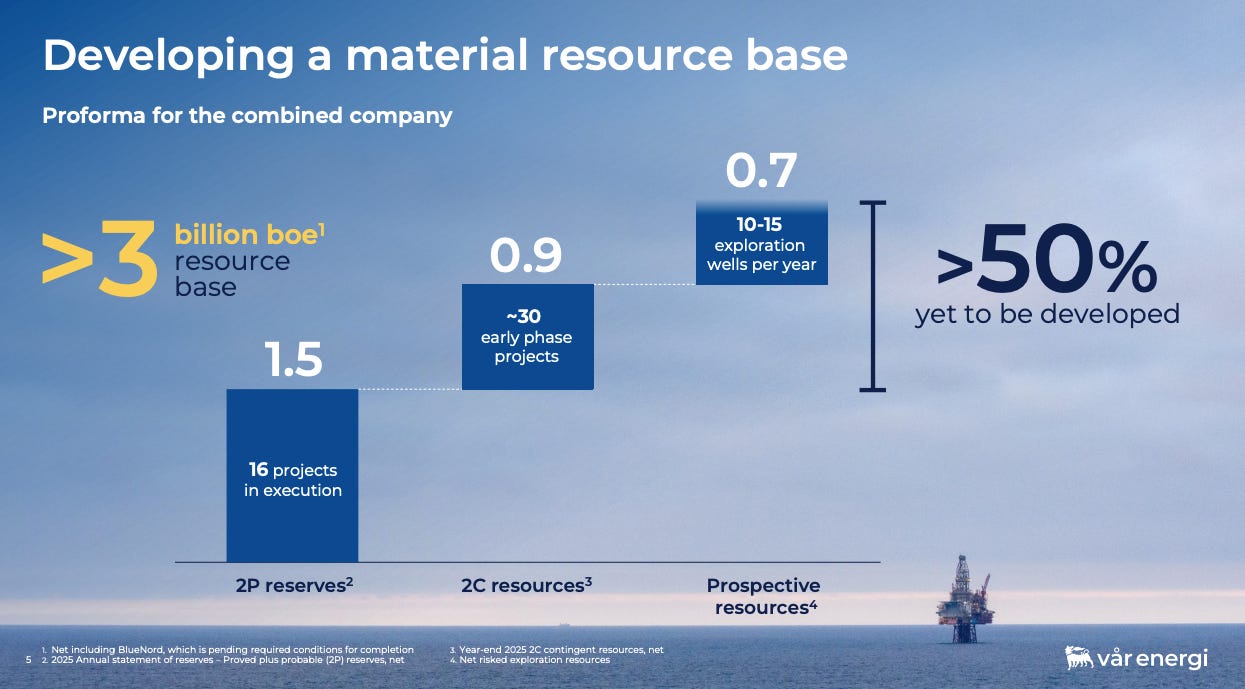
Vår Energi, one of the biggest producers in Norway, showed 16 projects in execution, around 30 early stage projects, and a plan to drill 10 to 15 exploration wells every year. Their capital spending averages about $2.5 billion a year from 2027 to 2032. Not all of that is drilling, but the wells are real, and the rigs have to come from somewhere.
BW Energy showed development plans in Brazil and Gabon, and new positions in Angola and Namibia. They want to triple production by 2028.
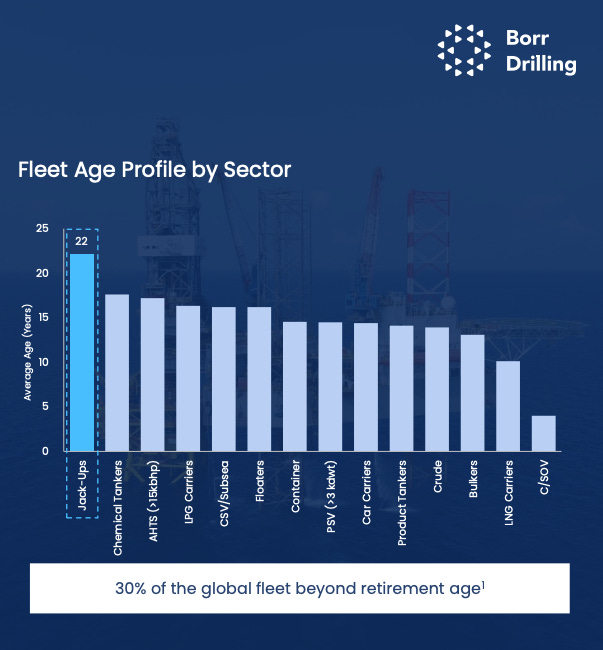
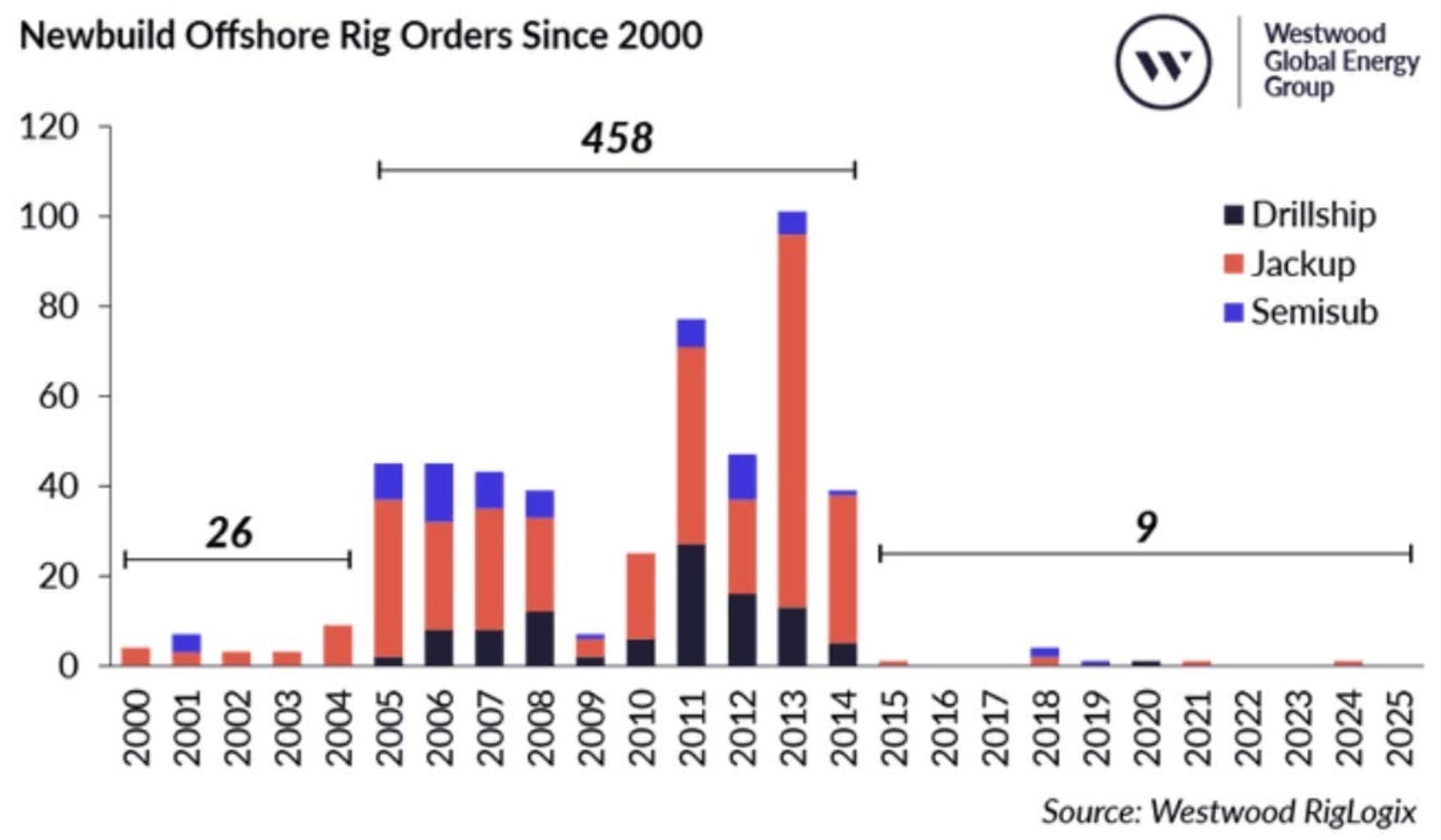
Even shallow water is full. Borr Drilling has 298 of its 324 rigs under contract. Twenty-six left in the world. And nobody is building. Thirty percent of the global jackup fleet is older than 30 years. The order book is 2 percent of the fleet.
6. Where Transocean stands
Transocean’s model, built on Wood Mackenzie, Fearnley and Westwood data, shows drillship utilization in the mid 90s through 2027. Harsh environment semis go higher. For parts of 2027 the active fleet is essentially full.
Transocean’s own 2027 is now 81 percent contracted. In June it was 73 percent. Backlog is $7.7 billion. The average dayrate across that backlog is $461,000.
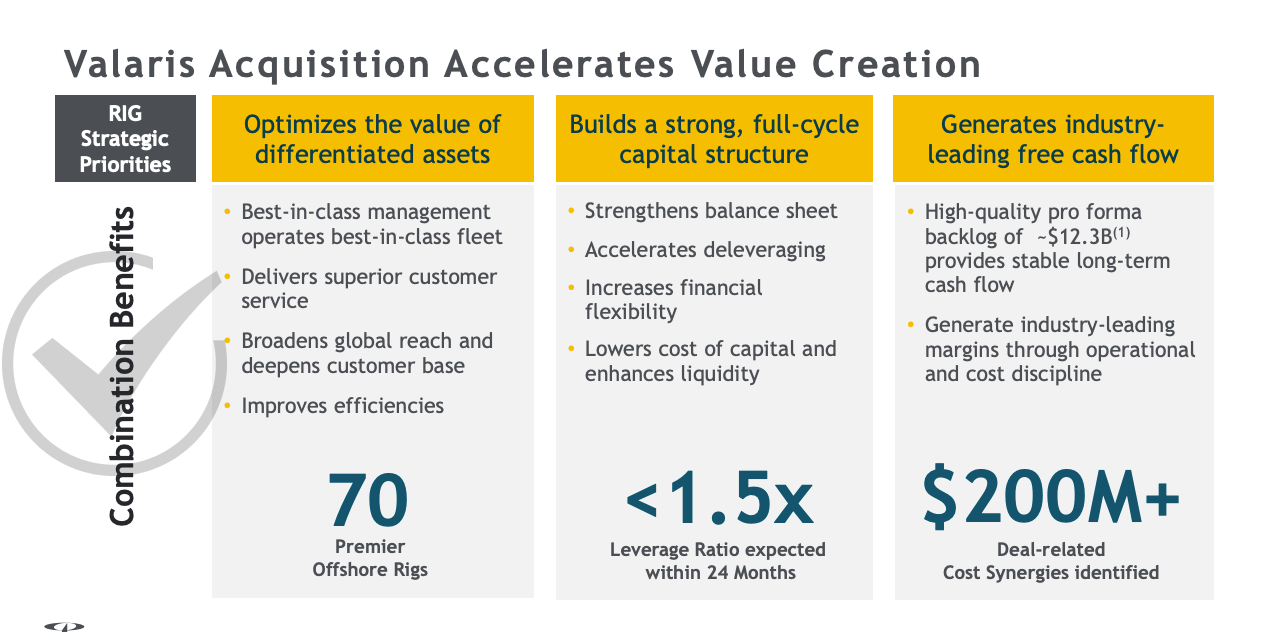
The Valaris acquisition is still on. In Oslo they repeated the numbers. $12.3 billion combined backlog, 70 rigs, $200 million in savings, leverage below 1.5x within two years. The Department of Justice sent a second request in May. Nothing in Oslo said it has been cleared, so that risk stays open.
7. What did not happen in Oslo
If I only showed you the bullish slides, I would be just another rig company. So here is the other side.
Dayrates have not moved. Transocean’s backlog averages $461,000. The contracts they signed since May also average about $461,000. The Conqueror job works out to about $471,000. Good numbers. Not a breakout. A year ago Westwood said near-term drillship rates were below $400,000 and that 2027 would tighten. The tightening arrived. The price is still catching up.
The full fleet is a forecast. Nobody has measured 2027. Transocean’s chart includes demand they expect, not demand that is signed.
Rigs can come back. Dolphin Drilling is reactivating the Borgland Dolphin. When the price is right, old rigs come out of the yard. Not many, not fast, but “no rigs left” is never literally true.
And 2025 happened. Contracting fell by nearly half last year. Offshore does not move in a straight line, and oil at $109 raises the odds of a recession as much as it raises drilling budgets.
One last thing
Everyone watching offshore is waiting for the dayrate chart to go up. I think that is the wrong chart.
Offshore contracts are negotiated a year or two before the rig starts working. The oil price this week is not in a single dayrate yet. It cannot be. Those conversations have not happened. They happen in 2027, when the fleet is full and the customers who did not reserve early are looking for the last open slots of the decade.
Transocean should be close to finishing its debt paydown around the same time. That is when it can start retiring shares. The market gets tight, the balance sheet gets clean, and the share count starts to fall, all in roughly the same window.
I do not know what the dayrate will be in 2027. Nobody in Oslo knew either. But the number of good rigs is fixed, the customers have started booking them years ahead, and the price has not noticed yet.
The rigs go first. The price follows.
Cheers, Sandro
Thank you for the informative article. I appreciate the detail. Did you hear anything in Oslo that gave you greater or lesser confidence that the Transocean/Valaris transaction will be successfully completed? To me, that uncertainty is disrupting the thesis on Transocean. What do you think? Thank you