


“That was a new scheme that people kind of laughed about when they first saw it. It looked kind of strange, but it worked much better and it became the standard.”
— Alden “Doc” Laborde, on the boat that built this company
In the early 1950s, supplying an offshore rig in the Gulf of Mexico was a comedy performed with leftover war equipment. Companies used converted shrimp boats and surplus Navy landing craft. The pilot house sat at the stern, the cargo up front, which meant a captain had to hold the bow, the part of a boat hardest to control, steady under a swinging crane in open water. Men got hurt. Cargo went swimming.
A Navy trained engineer from Marksville, Louisiana looked at this and had a thought so simple it took an outsider to have it. Flip the boat. Put the wheelhouse all the way forward. Leave the entire deck behind it open and flat, back the stern up to the rig, and hold position with power.
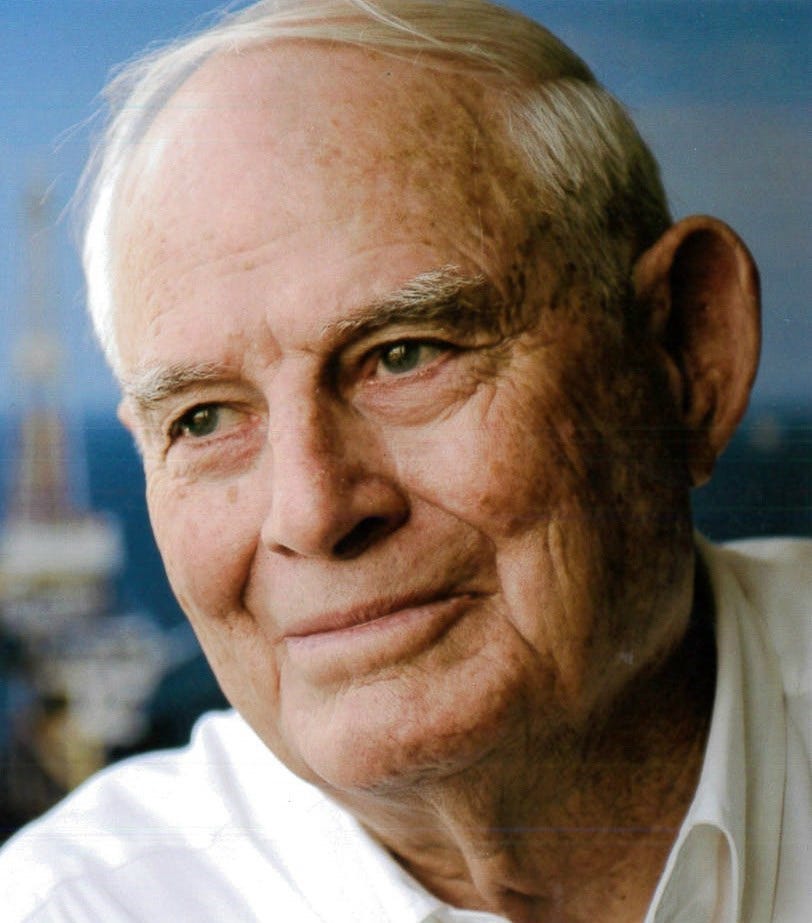
His name was Alden Laborde. Everyone called him Doc. And this was already his second act. A few years earlier, as a drilling superintendent, he had designed the first transportable offshore drilling rig. His employer passed on the idea, so he quit, knocked on doors until Murphy Oil funded half, and built it anyway. The rig was called Mr. Charlie, and it went to work for Shell at what Laborde himself called the “incredible sum of $6,000 a day.”
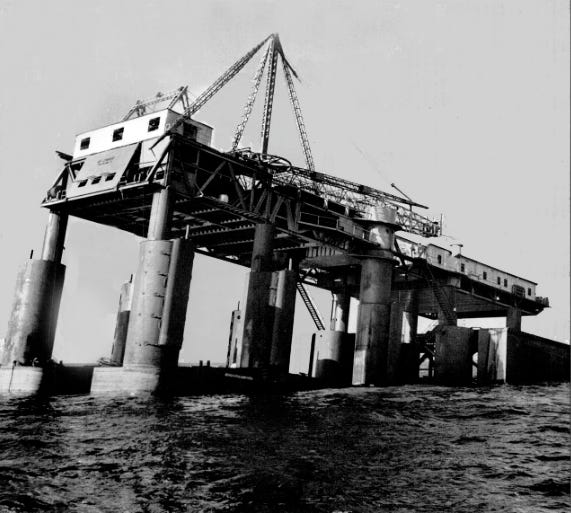
Now he wanted to build the boat that would feed rigs like it. He gathered ten men, including his brothers, at $10,000 each. The boat cost $225,000 at a New Orleans yard, 120 feet long, 90 of them open deck. They named it Ebb Tide and launched it in 1955. The industry laughed at the strange backwards boat. Remember the laughter. A few hundred words from now it becomes an investment thesis.
Shell stopped laughing first. Before the Ebb Tide finished its first charter, Shell ordered an identical one. Phillips ordered the third. By the end of the first year the little partnership ran eleven boats. The Louisiana oil association would later call Laborde the offshore industry’s equivalent of the Wright brothers, because one man had now invented both the mobile rig and the vessel that supplies it. Years later a young Texan named George Bush came by his office asking how to get into offshore drilling, and Doc helped him start Zapata.
The backwards boat became the standard for the entire planet. Roughly three thousand working vessels today, on every offshore field on earth, carry Doc Laborde’s layout.
Seventy years later
The company those ten men founded is still here. It is called Tidewater, it counts its seventieth birthday this year, and it is still what it was in 1956, the largest owner of offshore support vessels in the world. Just over 200 ships, in more than 30 countries, average age 13 years, the youngest large fleet in the industry.
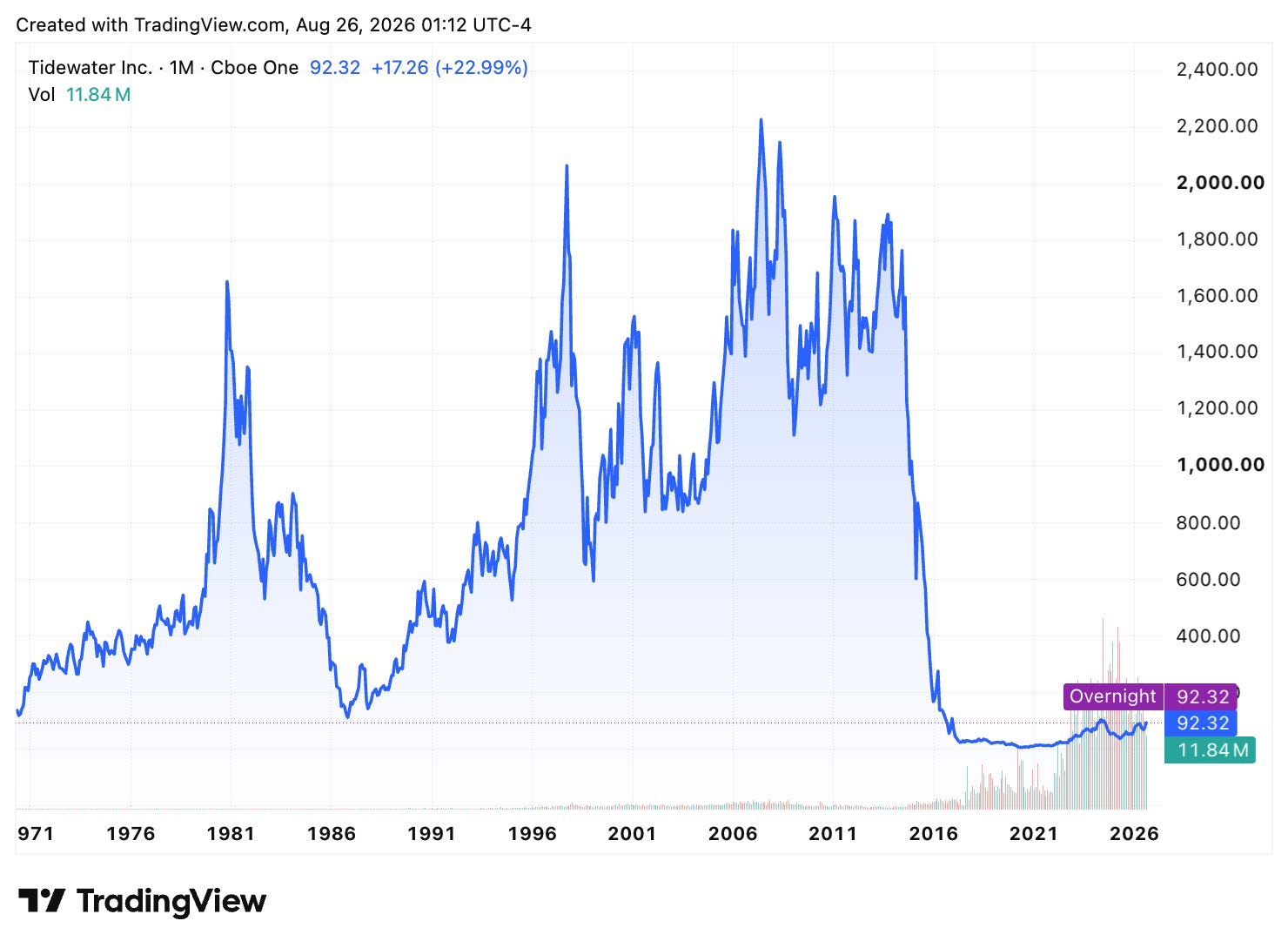
It survived every oil bust since Eisenhower. Then 2014 broke something even Laborde’s company could not absorb. After 62 years without a bankruptcy, Tidewater filed Chapter 11 in May 2017. The stock went from $59 to 68 cents. Shareholders kept 5 percent and some worthless warrants. Three thousand people lost their jobs.
So why am I writing about a 70 year old shipping company with a bankruptcy scar?
Because of one number. Four percent.
That is today’s global orderbook for these vessels, as a share of the existing fleet. At this point of the last cycle it was 34 percent. The industry that Doc Laborde invented has, for all practical purposes, stopped building his machine. And the company that owns more of these machines than anyone is priced at 40 percent of what its steel would cost to replace.
Continue the Tidewater series
Who Really Runs Tidewater (TDW)? A Management Deep Dive
Below the line, the full arithmetic. Why nobody builds, with the three numbers that prove it cannot change before 2029. The math of what this fleet earns as day rates climb, worked out to the dollar per share. The one company that finally dared to order new boats, and what happened to their confidence since. Who is buying the stock. What kills the thesis. And one specific day rate number that would restart the world’s shipyards, which is also, and here is the twist, the number that tells you exactly when to sell.
