“You can turn any investment into a bad deal by paying too much. What you can’t do is turn any investment into a good deal by paying little… We try to buy good businesses at a decent price.” - Warren Buffett, Berkshire Hathaway Annual Meeting, 2009
I have a problem with myself. I still struggle to pay up for wonderful businesses. I keep catching myself drifting toward cigar-butt opportunities, even when the quality is obvious. I know the theory, the examples, the math and yet the instinct to avoid higher prices keeps pulling me back toward “cheap.” That’s why, over the past few days, I went back and restudied Buffett’s 1972 acquisition of See’s Candies, arguably the greatest lesson ever recorded on paying up for quality.
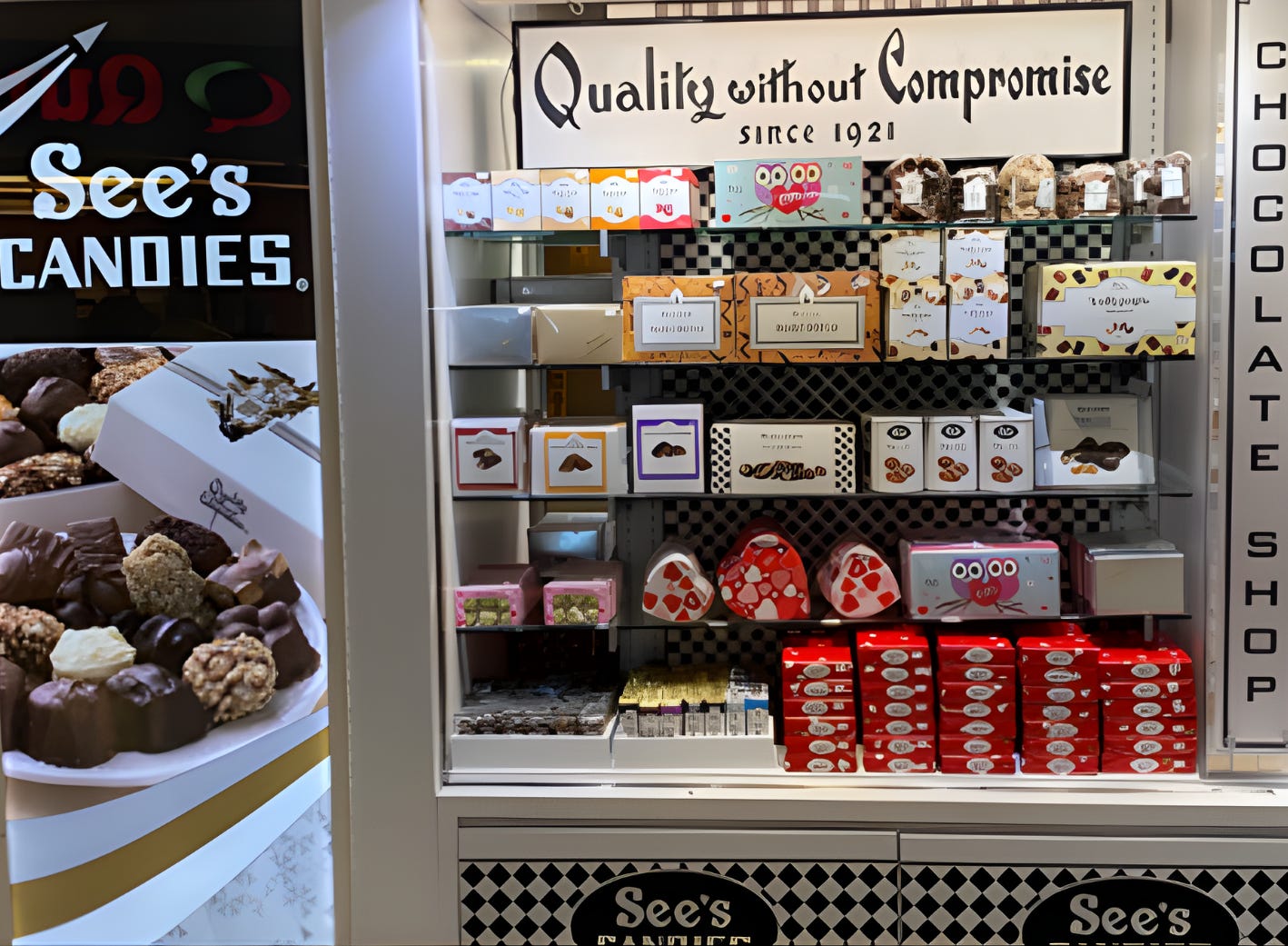
In 1972, Buffett and Munger bought See’s Candies.
The price was $25 million, and even that nearly killed the deal. Buffett thought it was outrageously high. See’s was generating about $2 million in annual cash flow, had roughly $8 million in net book value, and Berkshire was offering more than three times book. When the See’s family pushed for $30 million instead of $25 million, Warren almost walked away. His reaction was basically: “At $25 million and one cent, I’m out.” Yet the deal still closed.
Once they bought See’s, they kept the management exactly as it was. Chuck Huggins stayed in charge, the culture stayed intact, the operations remained unchanged. Buffett altered only one thing — pricing.
Every January 1st, Warren raised the prices. He looked at inflation, then pushed prices far beyond what any traditional operator would consider. If inflation was 3%, Buffett might raise prices 11%. And year after year, he discovered something extraordinary.
Pricing power didn’t hurt sales. Customers didn’t leave. Volume stayed stable. Sales kept rising.
So how good was paying up for See’s?
See’s doesn’t publish full financials, but I found that by 2011, the business had already generated about $1.65 billion in cumulative pre-tax profit for Berkshire. Today it earns roughly $100 million a year, and by 2026 total cumulative profit is on track to reach around $3.15 billion pre-tax.
Measured against the original $25 million purchase price, that’s roughly a 120–130× return.
And Buffett almost walked away. He refused to pay a dollar above $25 million. Yet even if the price had been $50 million, $80 million, or $100 million, the outcome would still have been extraordinary. He came close to missing a 120–130× return over a tiny difference in price.
If See’s Candies had asked $100,000 more, Warren and I would’ve walked; that’s how dumb we were at that time…” - Charlie Munger, 2003 Meeting
In this write-up you’ll find:
My new position — and why it’s so large
Growth, returns on invested capital, competitive advantage and valuation
Thoughts on my portfolio