


“He’d find something that was selling for one-fourth of liquidating value. He’d load up. So for a long period of time, he had a happy hunting ground. All he had to do was go through lists of liquid securities and slowly buy them, and he could get these ridiculous bargains.”
Charlie Munger
This post is part of a new series that steps inside Warren Buffett’s mind — exploring how he invested small sums of money at the very start of his career. We’ll look at his biggest wins, his missteps, and the timeless lessons that shaped the greatest investor of all time. Studying Buffett’s early moves teaches us far more about real investing than any Harvard Business School degree ever could. In those early years, Buffett was buying businesses below their liquidation value — meaning he could close them, sell the assets, and still walk away with a profit.
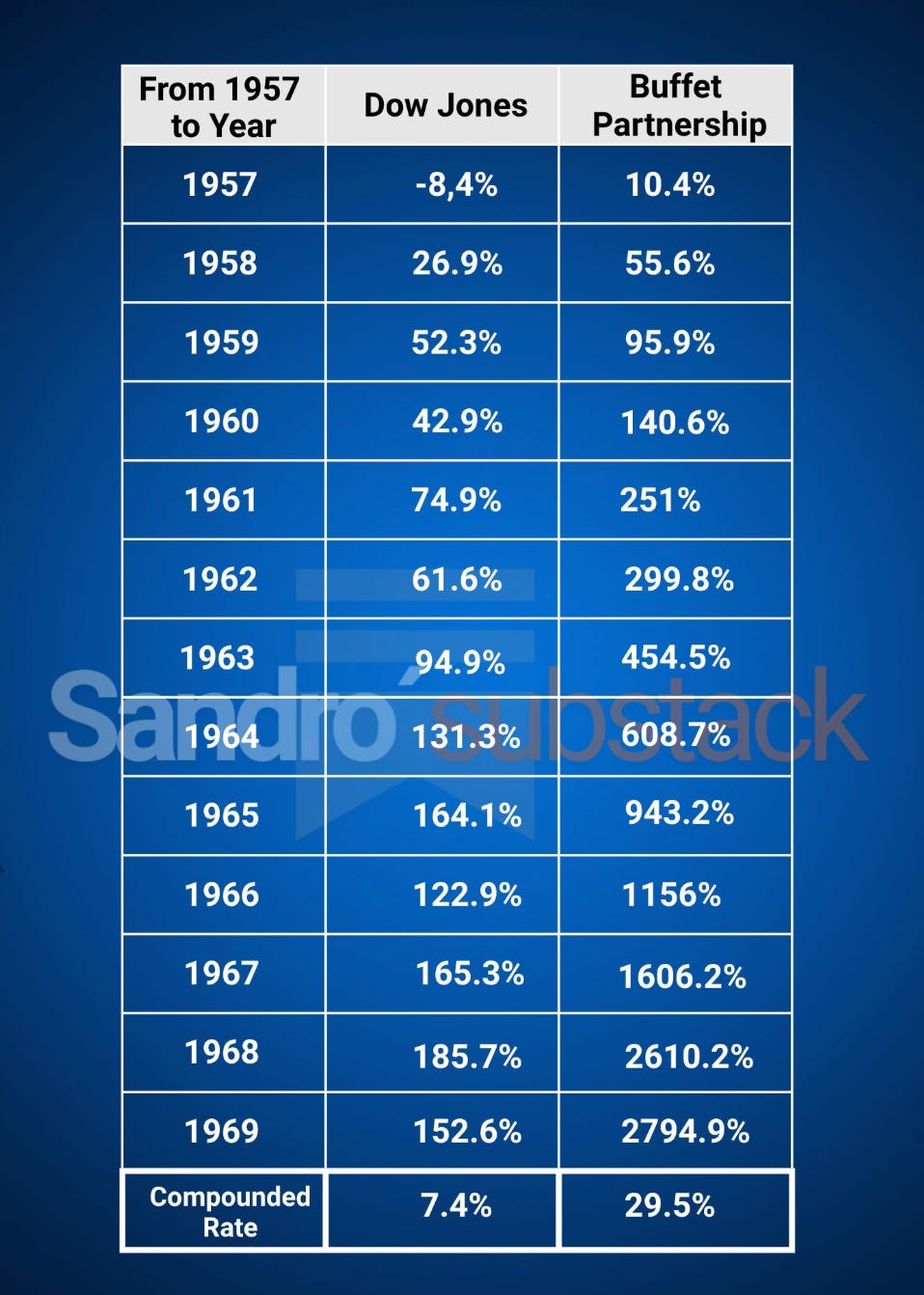
From 1957 to 1969, Buffett’s partnerships compounded at 29.5% per year, turning $1,000 into nearly $26,000, while the Dow Jones barely moved.
The early portfolio
Marshall-Wells (1950)
Greif Bros. Cooperage Corporation (1951)
Cleveland Worsted Mills (1952)
Union Street Railway (1954)
Philadelphia and Reading (1954)
British Columbia Power (1962)
American Express (1964)
Studebaker (1965)
Hochschild, Kohn & Co. (1966)
Walt Disney Productions (1966)
My posts about Buffett’s first investments with small amounts of money can be found here:


This post focuses on Cleveland Worsted Mills (1952) — a textile manufacturer once among the largest producers of worsted wool fabrics in the United States. The company supplied high-quality yarns and cloth for men’s suits and uniforms, but by the early 1950s it was struggling under rising costs and foreign competition — precisely the kind of neglected, asset-rich business Buffett loved to buy.
Why Buffett Bought Cleveland Worsted Mills
In 1952, Warren Buffett was working at Buffett-Falk and applying his mentor Benjamin Graham’s deep-value approach — buying stocks below their net current asset value.
Cleveland Worsted Mills, a major wool and worsted fabric producer based in Ohio, fit that formula perfectly.
According to Buffett’s own memo at the time:
• Price range: $84–$100 per share
• Net current assets: $149.95 per share
• Tangible book value: $184.69 per share
• Earnings per share (EPS): $16
• Dividend: $8 per share (≈8% yield at ~$95 mid-price)
• P/E ratio: 5.1×
• EV/EBIT: 1.1×
• P/B: 0.55×
Buffett wrote that:
“ The 8% dividend provides a well-protected yield on the current price.”
To Buffett, it looked like a low-risk, high-reward setup: strong balance sheet, solid dividend, cheap valuation, and tangible assets backing the price. He paid around $85–$100 for something worth nearly $185 on the books, collecting an ~8% dividend while waiting for the market to notice.
What Happened Next
At first, everything looked fine — steady profits, high dividend, strong balance sheet. But soon after Buffett recommended the stock to clients, the company’s earnings collapsed by more than 70%, and in 1954 management cut the dividend in half.
Buffett was stunned. Not only did he own the stock himself, he had also advised others to buy it.
Determined to understand what went wrong, he traveled to Cleveland to speak with management, but he arrived five minutes late and missed the meeting. A director later explained privately that falling demand for heavy wool, rising competition from synthetic fibers and southern textile mills, and years of industry overcapacity had crushed margins.
The company’s president, Louis Poss, eventually decided to liquidate Cleveland Worsted Mills. Although the textile business was dying, the liquidation turned out to be surprisingly profitable: as assets were sold off, shareholders received generous payouts. In total, investors earned about a 21% annualized return through the liquidation process.
For Buffett, it was a bittersweet win, as the investment “worked” financially, but only because the company shut down. Cleveland Worsted Mills was one of Buffett’s early “cheap but dying” investments, the kind that looked mathematically perfect but economically doomed. He bought tangible assets, strong coverage, and a fat dividend… but not a durable business.
Years later, Buffett described this type of thinking with brutal honesty:
“If you buy a stock at a sufficiently low price, there will usually be some hiccup in the fortunes of the business that gives you a chance to unload at a decent profit — even though the long-term performance of the business may be terrible. I call this the ‘cigar-butt’ approach to investing. A cigar butt found on the street that has only one puff left in it may not offer much of a smoke, but the ‘bargain purchase’ will make that puff all profit.”
He bought the stock for around $90, while the company’s net current assets were worth $150 per share. When the firm was liquidated, its cash and asset sales exceeded the market price he paid, and investors received multiple special dividends and liquidation payouts over the next few years.
Those distributions — combined with the regular 8% annual dividend — produced a total return of roughly +80% in three years, or roughly 21% on a compounded annual basis.
What Buffett Saw in Mills, I See in Coal and Rigs
Seven decades later, the same psychology repeats — a different industry but the same logic in motion. Investors still underestimate real assets, undervalue balance sheets, and lose patience just before the cycle turns.
I am not trying to copy his cigar-butt playbook, but I am paying close attention to places where hard assets and cash flows are priced as if the business were already dead.
The timeless lesson remains: buy good businesses that can become wonderful investments. A great business is not always a great investment, but every once in a while markets misprice quality so deeply that it becomes impossible to ignore.
In my latest post, I reveal my full Q3 portfolio. It holds four companies that, in my view, would be worth several times today’s market price if they shut down operations tomorrow and simply sold their assets. These are asset-heavy businesses that the market still overlooks, despite the tangible value sitting on their balance sheets. Yet pricing suggests investors assume no one will ever pay up for those assets.
The full breakdown sits inside the Q3 update for readers who want to see the numbers behind that gap.

At this point, even Buffett’s old mills look expensive 😅
Cheers, Sandro