


“I can live with a slightly lower return on equity and lower earnings-per-share growth, but at least I will live.”
— Pulak Prasad
Look at the chart before you read a word.
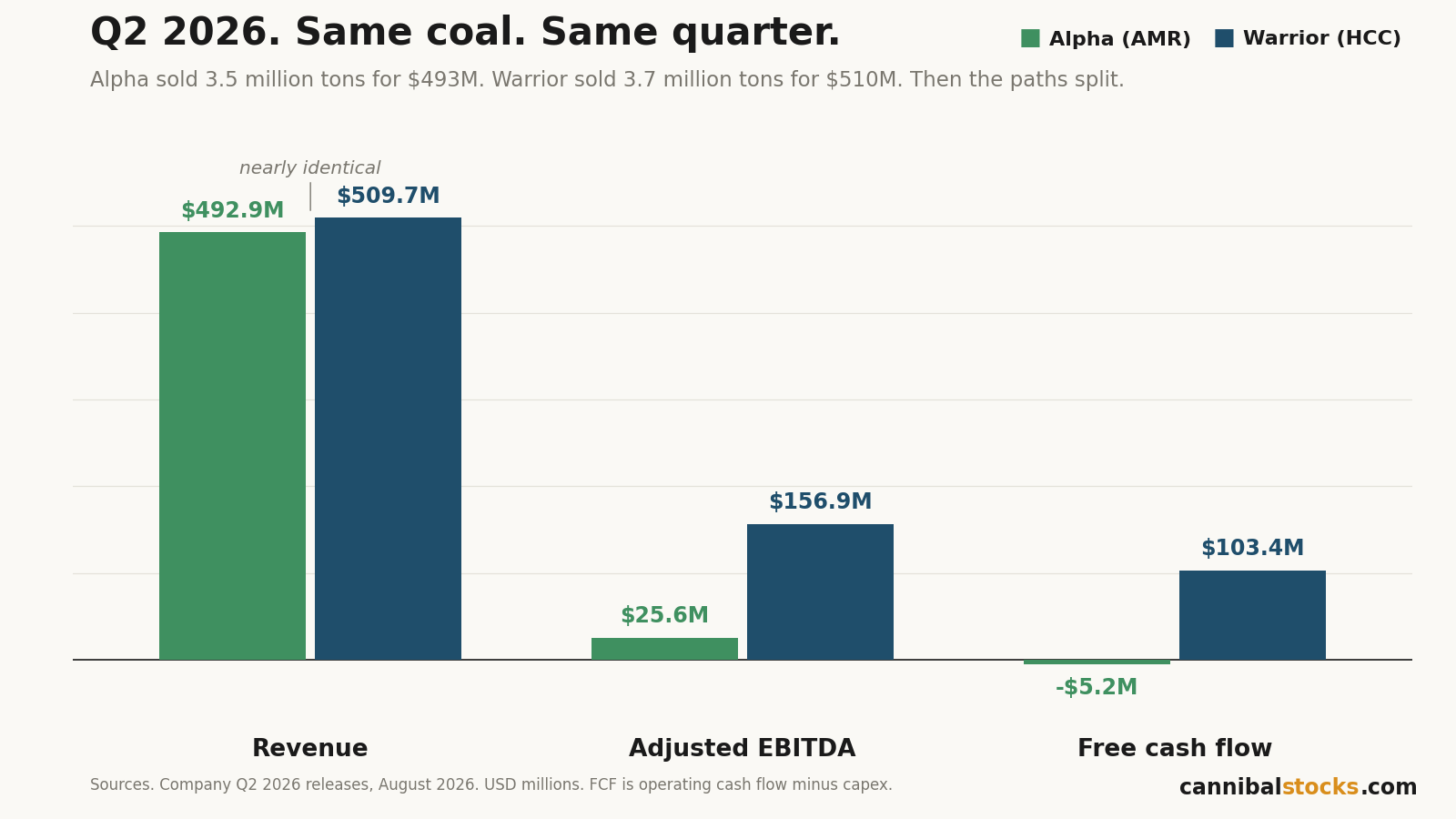
Alpha sold 3.5 million tons of coal in Q2 for $493 million of revenue. Warrior sold 3.7 million tons for $510 million. Then the paths split. Warrior kept $157 million of EBITDA and $103 million of free cash flow. Alpha kept $26 million of EBITDA and lost money.
Same coal. Opposite outcomes. This post explains where the money goes.
One note on timing. I wrote this last week, with Alpha near $157. It closed at $194 on August 19, up almost 15 percent in a single session. Every price in this post is from the time of writing, so the discount is narrower than the arithmetic below suggests.
Warrior is the better business
This is not close, and pretending otherwise would insult you.
Start underground. Warrior mines with longwalls, giant shearing machines that cut coal at a fraction of the labor per ton.
Alpha runs mostly room and pillar sections, which need more people and more machines for every ton.
That single difference puts Warrior in the bottom quartile of the global seaborne cost curve. In Q2 the gap was $92.53 against $103.07 per ton, and it persists through every cycle.
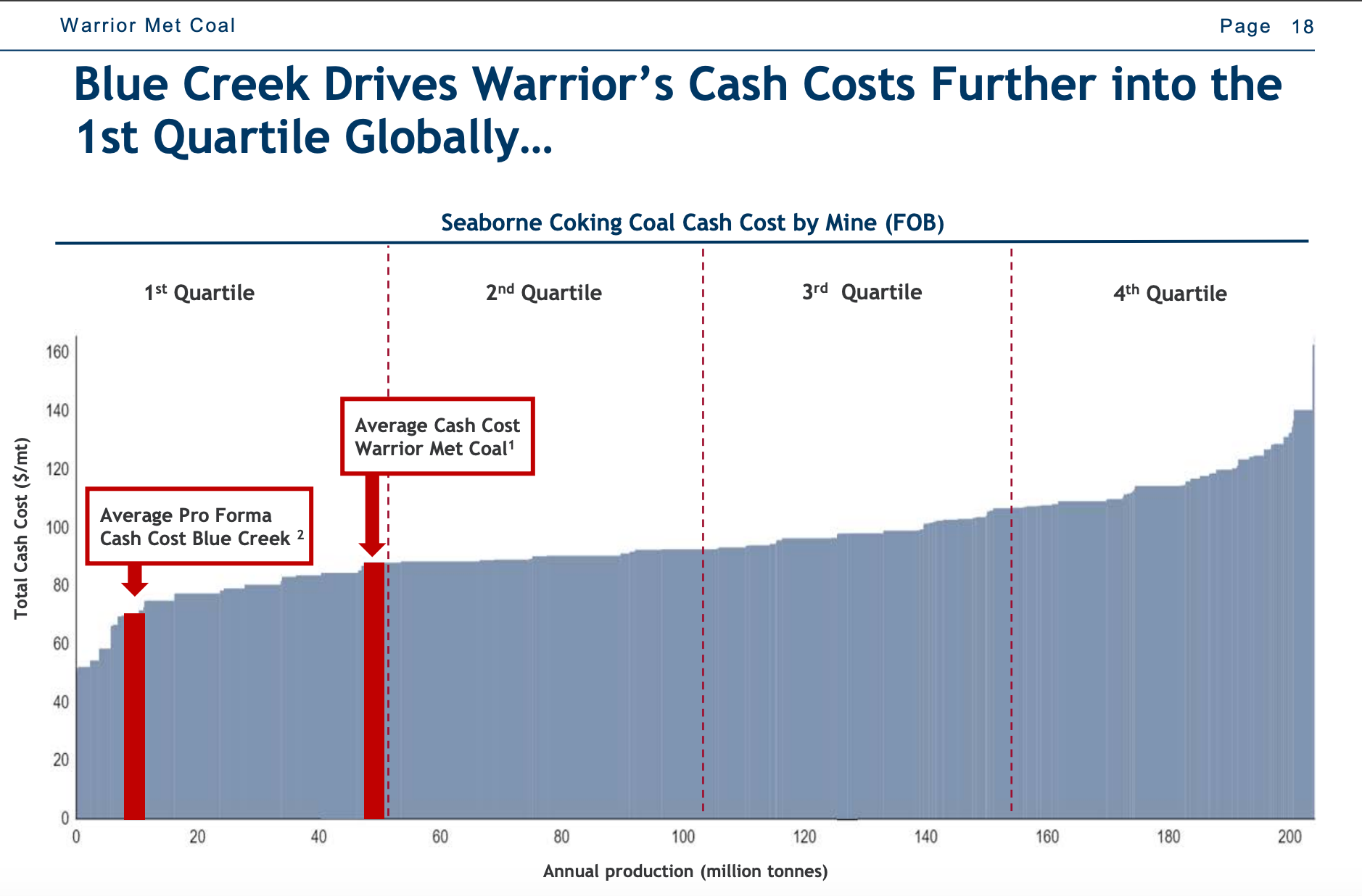
Then the path to water. Warrior reaches the port of Mobile by rail or by barge. Two options mean pricing power against the railroad. Alpha depends on a single railroad to reach the East Coast. Warrior’s inland freight at $15 to $30 per ton against $25 to $60 for Central Appalachian producers. Cost is measured when the coal touches the water, and Warrior touches it cheaper.
Then the growth. Warrior just brought Blue Creek online, a brand new longwall mine, and raised 2026 guidance to 13 to 14 million tons because customers are taking the coal as fast as it comes. At benchmark prices near the cycle floor, Warrior’s own March math pointed to more than half a billion dollars of annual cash flow. In the worst met coal market in years, Warrior prints money. Alpha, in the same market, idles mines and defends a balance sheet.
Case closed. Better mines, better logistics, better costs, better cash flow. Warrior is the wonderful business.
Now the twist that binds these two companies. Blue Creek, Warrior’s crown jewel, is a high vol A mine. It belongs to the roughly 11 million tons of new longwall supply that broke the price of exactly the coal Alpha sells most of. The spread between premium low vol and high vol A went from $5 per ton in early 2025 to over $30 today. Warrior’s own realization collapsed to 66 percent of the benchmark under the weight of it, down from 80 percent a year ago.
The best business in the sector built the flood its neighbor is drowning in. Warrior can afford the flood. Alpha cannot, which is why it trades like a company in trouble.
So buy Warrior and move on?
Not so fast. A stock is not a company. A stock is future cash flow divided by a share count.
And the moment you divide, the picture inverts.
Related AMR and HCC research
Alpha Metallurgical Resources (AMR): The Long-Term Investment Thesis
