


Part 3 of the Li Lu series. Part 1 was Timberland.

Part 2 was the numbers.

This is the people.
November 2, 2023. 8:30 in the morning. Third quarter call.
Jonathan Komp from Baird gets the first question.
When you bought HEYDUDE you talked about a billion dollars of revenue in 2024. Is that still realistic, or has it been pushed out?
Andrew Rees answers.
“Yes, I think we’re very confident the brand will be north of $1 billion in 2024.”
Seconds earlier, answering the same question, his CFO had guided HEYDUDE’s fourth quarter down 20 to 25 percent. The company was cancelling wholesale orders and cleaning up inventory at its retail partners.
Everyone on the line heard both things in the same minute.
2024 came in at 824 million. 2025 at 715. In the second quarter of 2025 Crocs wrote off 737 million dollars of the brand.
The consultant
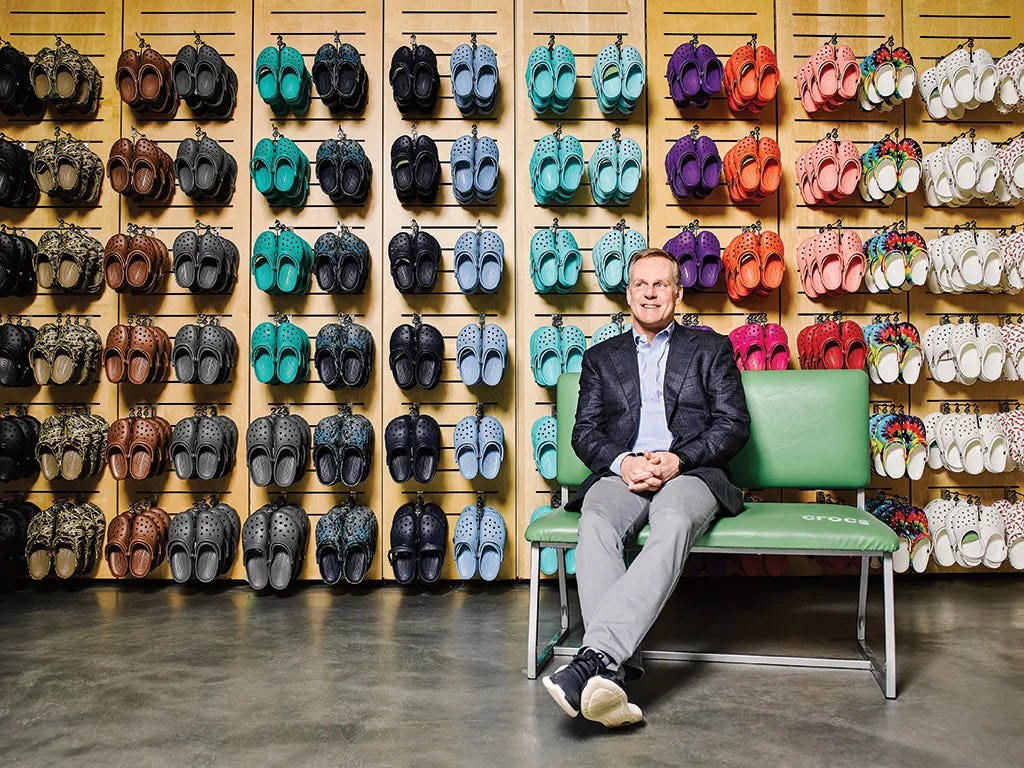
Andrew Rees was born in Carlisle, in the north of England, in 1967. Laura Ashley. Reebok, where he built the retail arm. Then thirteen years at L.E.K. Consulting in Boston, where he founded the retail practice.
In 2013 Crocs was a 1.2 billion dollar company going nowhere, with over 600 stores and a CEO on his way out. Blackstone put in 200 million and took two board seats. Somebody had to write the turnaround plan. L.E.K. got the job. The partner on the account was Rees.
Six months later he was President of the company he had been consulting for. Three years after that, CEO. He was, in effect, the consultant on his own hiring. No filing says Blackstone picked him. The sequence says enough. So does the exit. Blackstone was out by 2019 with the stock at more than double where it came in.
What he built
2014, revenue 1.2 billion, operating income minus 5 million. 2015, minus 72 million. He closed 104 stores in the first year and cut 185 jobs. From 2017 to 2019 the store count went from 558 to 367. By 2019 the same 1.2 billion of revenue produced 129 million of operating income. Then the pandemic and the clog and 2021, 2.3 billion of revenue at a 30 percent margin.
He did not inherit today’s Crocs. He made it. The options he exercised this August were struck at 6.98 dollars. He was there when this was a seven dollar stock, and he is the main reason it is a 140 dollar one.
Hold that thought. Everything below is the other half.
The deal
December 23, 2021. Two days before Christmas, when nobody is watching. Crocs announces it is buying HEYDUDE for 2.5 billion dollars. Just over two billion in cash, all of it borrowed, plus 2.85 million shares to the founder.
Rees on the call.
“Never say never with regard to an acquisition.” The promise, “a billion dollar plus brand by 2024.” The price, “less than 15 times EBITDA.”
Now the sequence, because the sequence is the case.
In 2021 Crocs spent one billion dollars buying back its own stock at an average of 122. Then it borrowed two billion for a loafer. Then in 2022 the stock fell to 50 dollars, the cheapest it had been since the pandemic, and the company bought zero shares, because the loan agreement forbade buybacks until gross leverage fell below two times.
From the 10-K.
“… we do not expect this to occur in 2022.”
He bought near the top with cash. The covenant locked him out of the bottom. That is the whole capital allocation record in one sentence, written before HEYDUDE sold a single extra pair.
Then Crocs pushed HEYDUDE into every wholesale door it had and reported revenue doubled. In April 2023 the market understood that a large piece of that was shelves being filled for the first time, and the stock fell 16 percent in a day. In July the company put a number on it. 220 million of pipeline fill.
What he said, in order
April 2023, the brand is “gaining momentum.”
November 2023, the call from the top of this post. “Very confident” of a billion in 2024, while guiding the quarter down 25 percent.
October 29, 2024, the closest he has come. “We definitely grew too fast.” And “in retrospect, we absolutely shipped too much product.” That is a real admission, and it took 34 months.
August 7, 2025, the write off quarter. The 737 million is “non cash.” The cause is “a longer than expected timeline,” “a weaker U.S. consumer,” and “the disproportionate impact of tariffs.” Rees’s own headline that day, “the highest ever gross profit quarter in company history.” Asked who was running the brand he had just written down, “the current leadership for HEYDUDE is myself.”
He said he shipped too much. He never said he paid too much. In seven calls the word mistake does not appear.
One detail from the impairment note. To value what was left, the company assumed HEYDUDE would grow 8 percent a year at a 20 percent EBITDA margin. A brand shrinking 13 percent a year. Even on those assumptions it was 737 million too high. The remaining 1.1 billion trademark sits less than 10 percent above its carrying value. One more bad year and there is a second write off.
Now, who paid for the first one.
